
Introduction
Just a little backstory. I am an IT professional for those who don’t know me in real life. I have been working in IT since I was 16 years old, I started as a Database administrator, and now I am a Senior Business System Analyst. I am a person who makes projects happen from a business and technical perspective. I help design IT systems and business processes. I am also a certified associate in project management, which is a big deal for a young professional. Saying all this to say – I am experienced in Project management, and this post is about how I brought those practices to the SCA game. Also, I hope this may help someone coming to the same problem, and they may use my lessons learned to deliver a better product at the end of the day.
In June, the new prince and princess of Atlantia were getting ready to jump into the sea of responsibilities feet forward. I offered my help with their needs in garbs, largess, and other items coordination. And the big mountain came my way (yes, this time, the mountain came to Mohamed).
Project description
The problem their royal highnesses (TRH) were facing was a lack of garb for one week-long event. The festival is out of state with limited access to laundry, and weather conditions may require you to change several times a day. In addition, due to the royal role, several outfits may be requested depending on events. For example – a special themed party required a roman outfit.
Project objectives and Key Deliverables
After consulting with TRH, it was decided that four sets of garb would be delivered:
- two pairs of Spanish outfits XIII-XIV century;
- one pair of Rus outfit X century;
- one pair of Roman Empire outfits;
- accessories to complement each garb.
Also, Countess Jane has offered to make one more pair of matching Spanish garb, and one sidles dress for Her Royal Highness.
Resources
Team resources:
- “Business sponsors”
- Project manager
- 1 full-time artist
- 2-3 part-time Artists
By artists, I assume people who can perform the following tasks:
- Process the provided research and period design and implement it with existing materials
- hand sew or machine sew clothes
- Weave
- embroider/fabric printing
The following material recourses are needed:
- The linen of different colors (each garb requires 3-4 yards of fabric)
- Wool (1 yard)
- cotton or silk for roman garb (8-9 yards)
- wool threads for weaving
- cotton threads for weaving
- cotton threads for sewing
- Serger bobbins
- Pearls
- stones
- bases for jewelry
- metal wires
Due to the short time span, the resources will be obtained as needed from donations and existing stashes.
The following tools will be required:
- Various size needles and scissors
- Sewing machine
- Surgery
- inkle loom
- wire weaving tools
- acryl
- printing blocks
High-level assumptions
- The scope of the project will not change due to the highly limited time.
- All products are delivered on time.
- Fabric and color selection is limited to the ones available already or available in nearby stores.
- The design and research are completed and approved before the actual work starts.
- The team will substitute the design part with cheaper/faster options in order to complete the project in time. Substitutes shall still be a part of the proposed period and resources appropriate for the time.
Constraints
- Time is highly limited.
- The budget is highly limited (matter of fact, no budget. On average, team members are able to donate 50-75 dollars worth of materials for this project)
- The scope defined at the beginning of the project cannot expand to more items.
Risks
- The other artists would not have time or materials to complete their tasks
- Resources sickness
- The quality of available material would not be acceptable.
- Miscommunication between team members
- Design is too complicated to complete in time
Process
side note. I am a big fan of Agile methodology when you deliver finished pieces of the project that are functional instead of waiting for all pieces to fall together to deliver. This methodology helps to identify the problems early on in the stage of the project and fix them cheaper, money, and time-wise. This works perfectly when you have a team working on the problem.
I did not have that. I had some resources here and there, but 90% of the work was on me at the end of the day. I ended up doing a mix of Agile and Waterfall. After the design was completed, I started with weaving, accessories, actual patterning, and sewing.
Planning included the Weekend when I could travel to another state to meet with other artists and collect their deliverables. During that day, the fabric printing was completed, and some final sewing by Countess Jane was completed so I could deliver the garb made by her to TRM.
Lessons learned
- One month is not enough time.
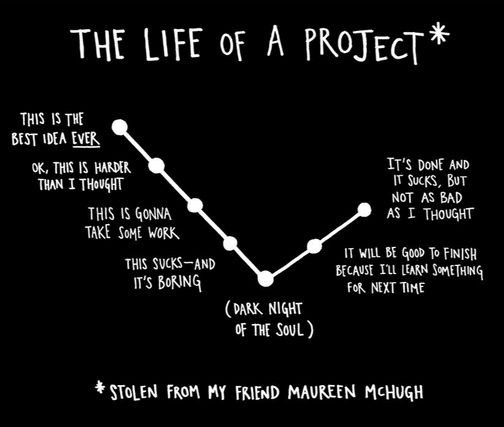
Let’s be brutally honest. Unless you have no full-time job/school and do not have any kids, and you have a full day on your hand, it is not feasible to get all of this done. How do I know this? I have been working on that every minute I have available at night. I was yet needed to complete my job responsibilities. So, in reality, I had nights. Literally – nights. It is not healthy.
In addition, it is impossible to find dedicated resources in such a short time. This is why you will end up with 98% of the tasks on you to complete.
- Material shortage.
I was happy with not all materials I selected, but on short notice, there is no time and money to shop around and hope for the fabric to be delivered in time. I was lucky enough to have some material donated that I could you along with getting in my stash.
Make sure you have enough extra material and tools if something goes wrong. Do you know how people look at the human at Walmart at 11 pm looking for machine needles because their last one broke on them? I know. I thought they would call mental asylum house stuff on me (well, it was my third day on caffeine and sugar with no shower, so I would not blame them).
- People shortage.
As I mentioned above, there is no way to find people, and I hope they will dedicate all their free time to this project for free in such a short period. I was lucky (yet again) to have people have my back and help me with whatever they could, and they delivered fabulous pieces to help me out and shared their knowledge.
- Not tested techniques and materials.
If you have a short time – work only with techniques and materials you know and tried 300000 times before. The time constraint adds stress to your plate as it is, and when something goes wrong because of the material quality, new technique, etc., it will not make it easier. In the post about the Rus Royal garb, I have described the issue I ran into with the trims, and it took me three mental breakdowns to finally go the route I knew, and it was close enough to have period pieces complete.
- Documentation.
Do your research before you start. Document every step and material selection. It will save you a ton of time in the future.
- Communicate with the client.
This one is tricky. I communicated and ensured that the design and ideas were approved and the methods worked. What I did not do was try on the clothes before the final sawing. I end up with some tight clothes because people’s bodies change. I took measurements once and went by them instead of having several try-on.
- Order of the tasks (critical path).
Plan to sew the clothes first. Accessories could be done at last. I had my reasons for doing it the opposite: I was waiting on fabric, I needed the fabric to be printed before I sewed it together, and I needed a trim to be done before I sewed everything together.
However, I could have used my patterns since they all were close enough to each other and made a test tunic from cheap cotton and used it for try-on. Nothing fancy, but it would make the cut and would have let me know what to adjust ahead of time.
- Scheduling.
Do you know how much time it takes you to make a tunic? For scheduling purposes – double it. It will let you make sure you have enough time to battle whatever issues you face. If everything goes wrong – you still have time on your schedule, and you will be able to focus and not be stressed out.
 Phoenix Safe Place