
This blog post is a documentation adaptation of my entries for the Kingdom Arts and Science Festival 2023 persona pentathlon. The series will have 5 blog posts for each item separately.

Spindle.
A spindle is a tool to spin the wool to speed up the highly manual process. Usually, the unspun wool would be placed on the stuff or pryalka (the board with the seat on it and the spindle would be held in hand and twisted in the same direction for the wool to be spun.
Archeology and visual anthropology analysis.
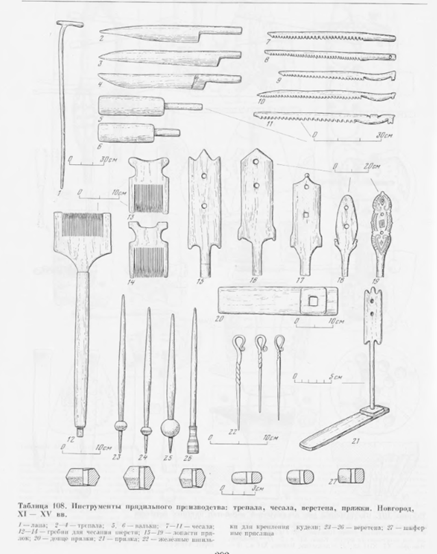
Tools of textile production. Pic. 23-26 are the spindle rods; pic 27 is the clay for the spindle. XI-XV century.
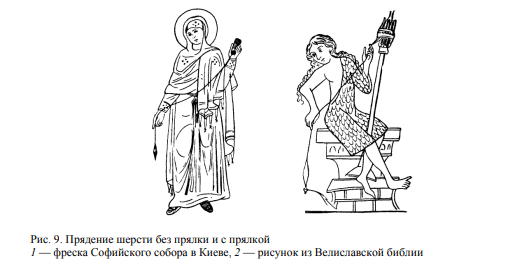
Wool spinning with and without a stuff. 1 – fresco from Sofia Church in Kyiv, 2 – picture from Velislav’s bible.
The weights for the spindles were made from clay. However, due to the production way described below, many items were lost in the fire, so many items were made possible to receive at least 10% of the outcome. Below is more advanced clay production tools that were used in trade skills.

Pottery ovens. XI-XIII cc.
Although this production option has been available to the public, pryaslitce (the name of the weight used on the spindle) was mainly made at home or by someone in the tribe’s commune.
Mainly this type of craft was a winter type of craft when there was no fieldwork or other work but in-house because of the climate, and it mainly was a women’s craft.

Fibers found in Novgorod lands.
Production.
I have attempted to produce the spindle and the weights for the drop weight loom from scratch at the event site – Elchenburg Castle.
First, I collected over 6 pounds of clay in the creek.
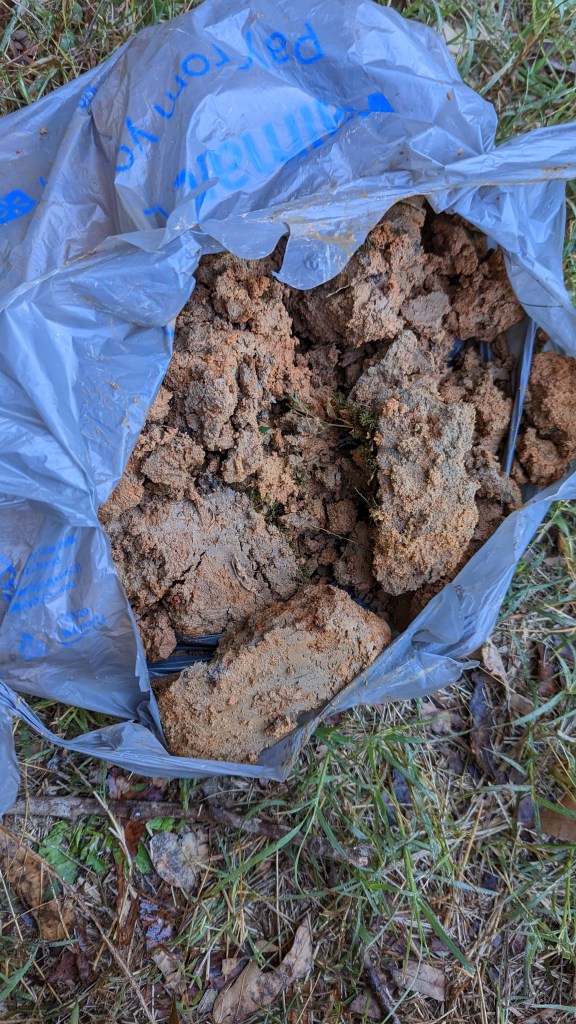
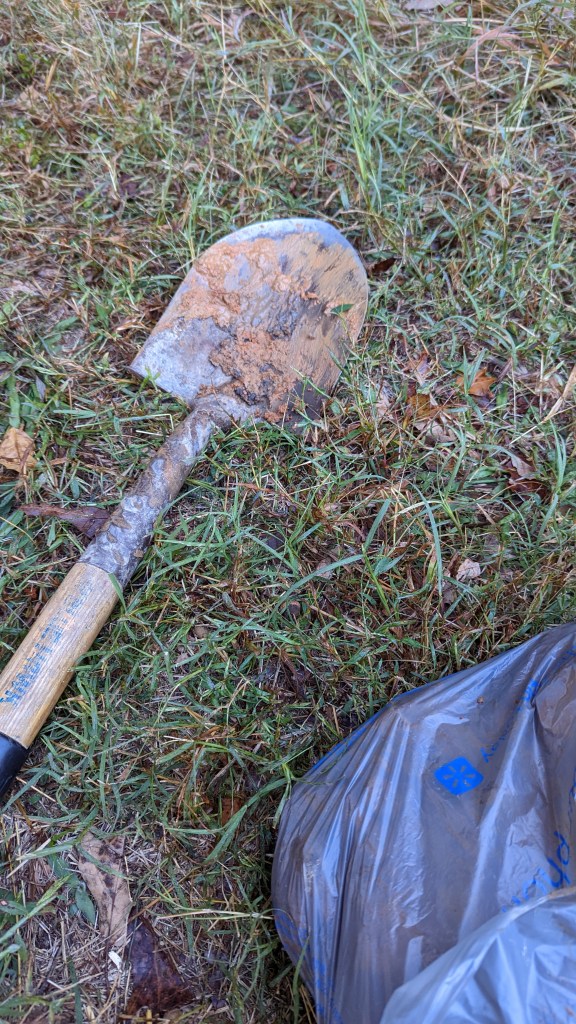
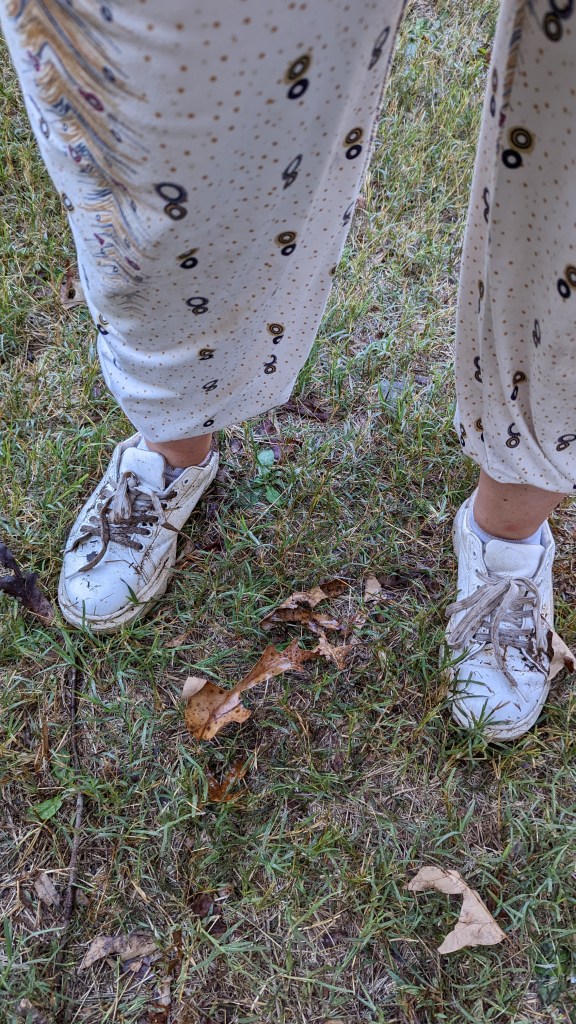
Before anything dried, I gathered water in the bucket and transferred all the clay in it in order to wash away the sand. The goal was to break clay lumps into small pieces to remove trash from them with the help of water.
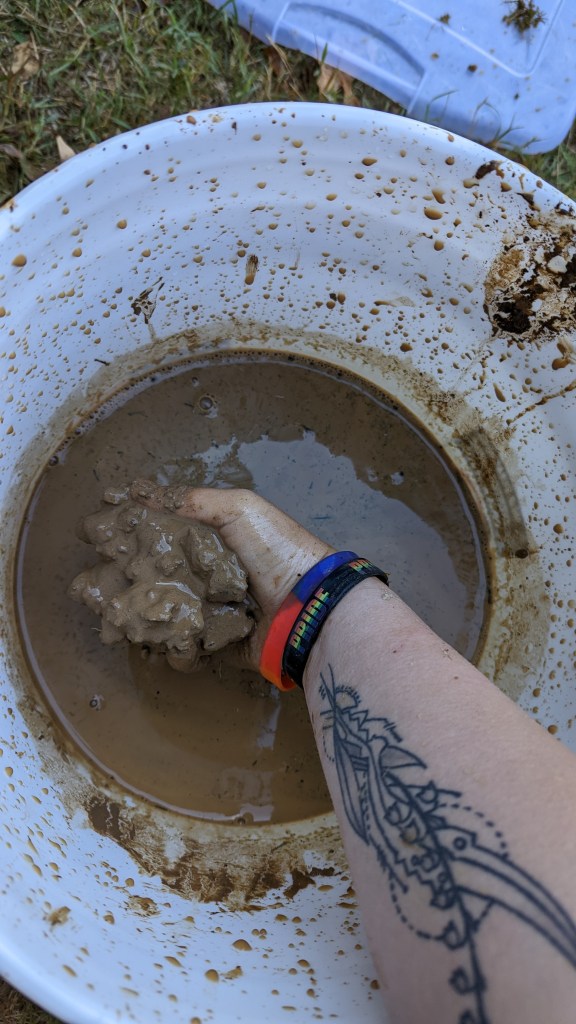
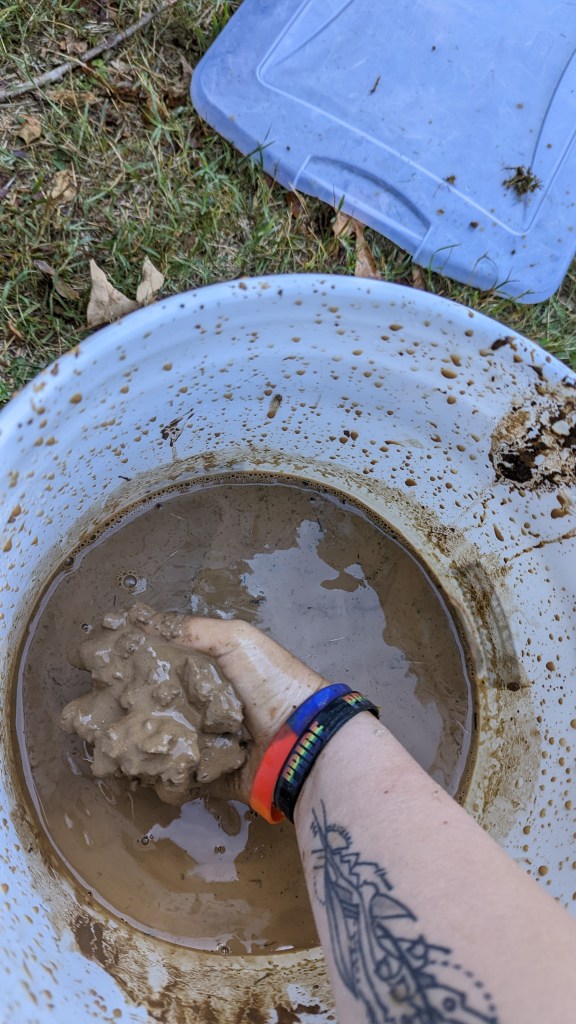
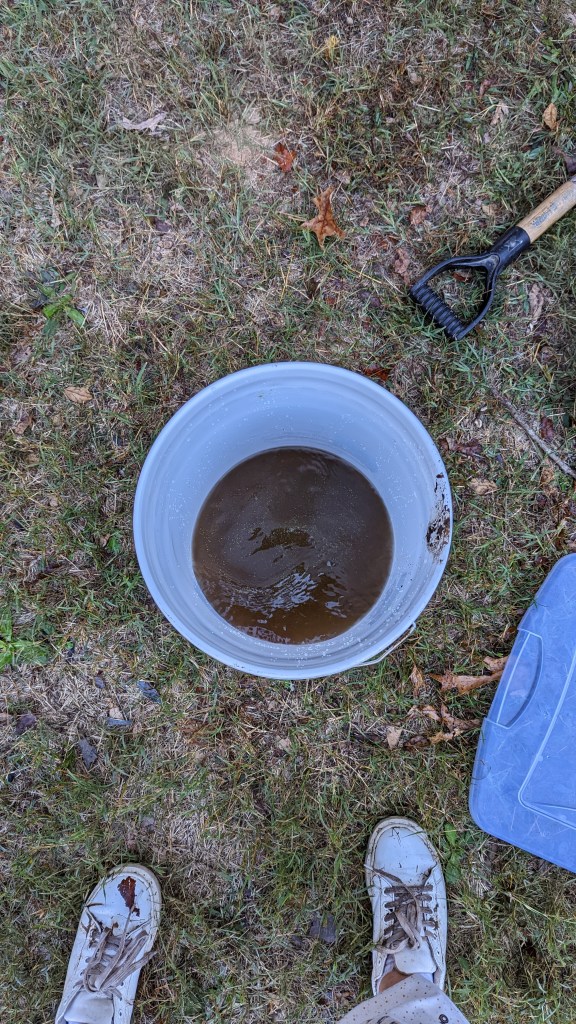
After all, the clay was broken apart, and I left the bucket to settle. Later in the day, I used a fire pit top as a griddle to run the clay through it to remove the last sand.
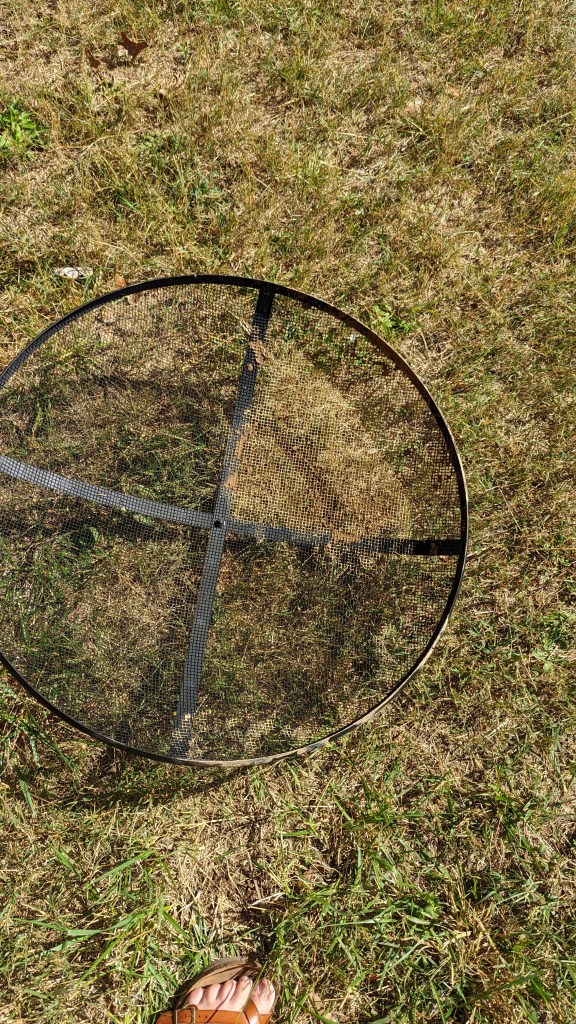
As I went with washing clay, I distributed washed clay evenly on the flat piece of wood.

Once the clay was soft but not soaking wet, I started making the “bagels” and distributed them on the same wood piece I used to dry. After that, I prepared the fire pit and started the fire.


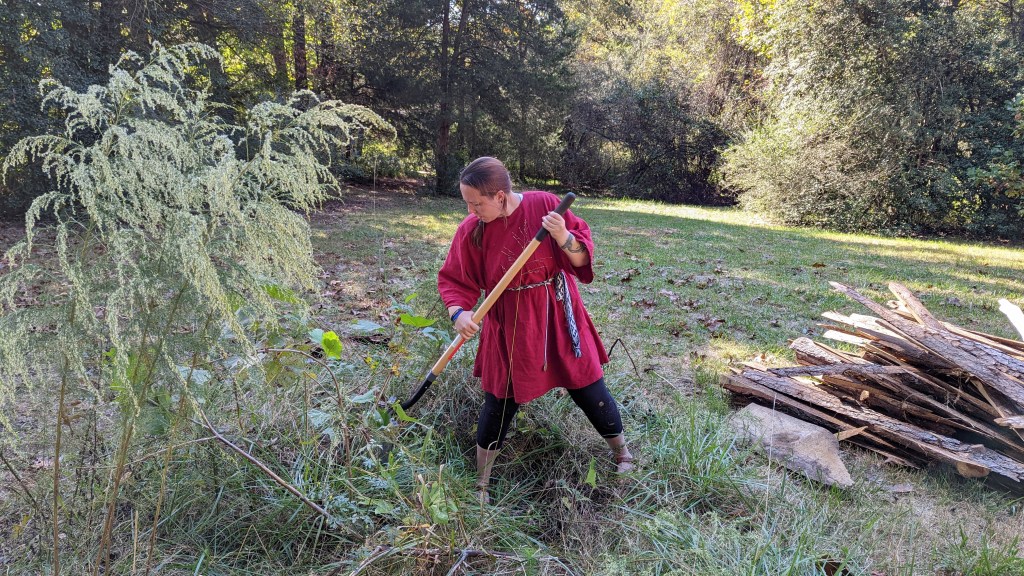
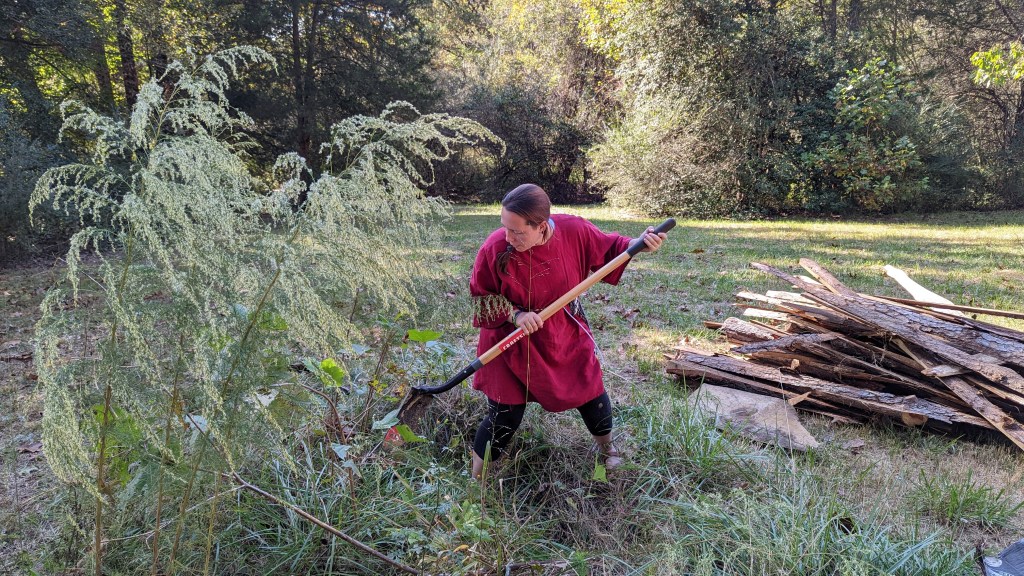

Once the desired temperature was achieved, I placed the wood on the fire’s edge to speed up the drying.

Later in the night, I placed the bagels in the hot coals and left them to cool with the fire going down.

In the morning, I dug out the results. Only two pieces have survived production, which is to be expected. Unsurprisingly, both pieces cracked into pieces by the end of the day.
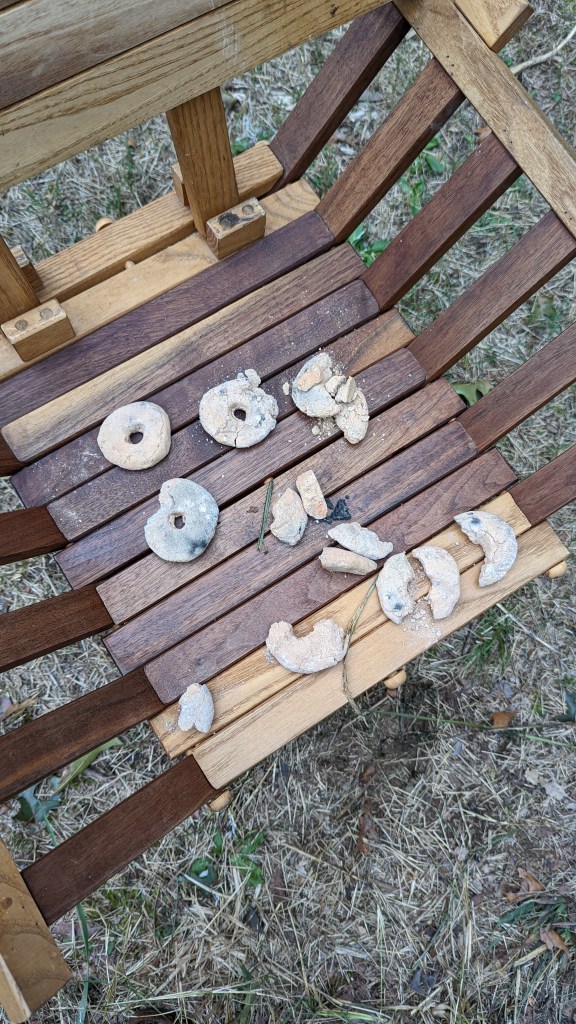
The problem with this experiment was the quality of the clay. Unfortunately, the pieces fell apart because the clay still had much sand that was impossible to wash.
I bought high-quality self-drying clay for the presented piece because I could not access the pit outside the event site.
I made the bagel and let it out dry for several days. Meanwhile, I prepped the wooden piece of the spindle by carving out the desired form with a wood carving knife.
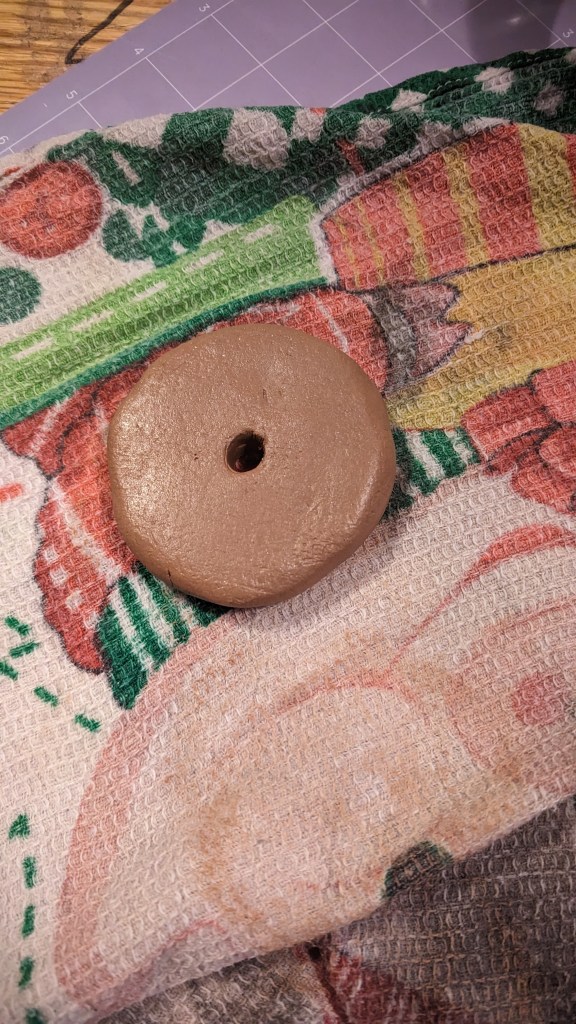
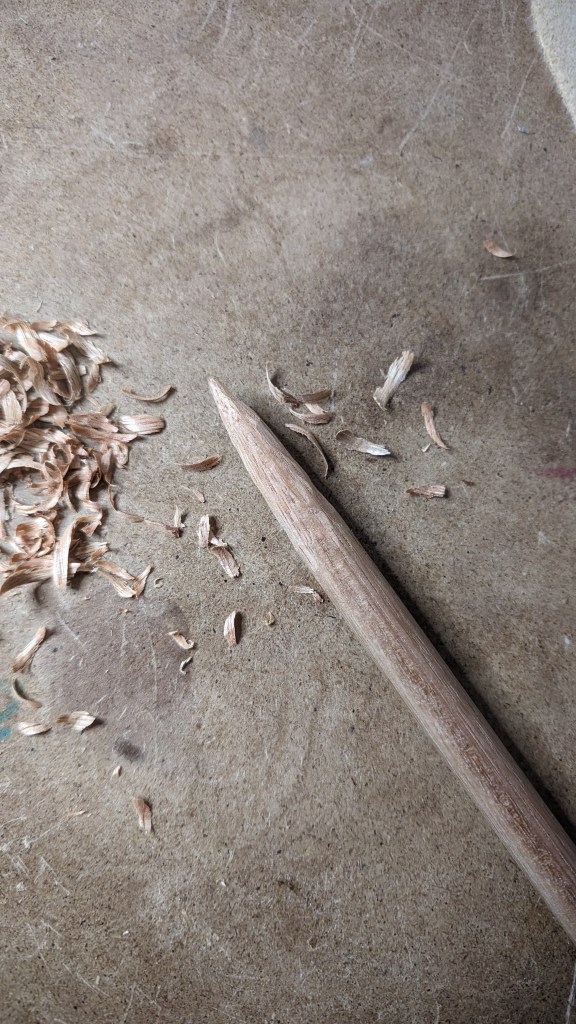
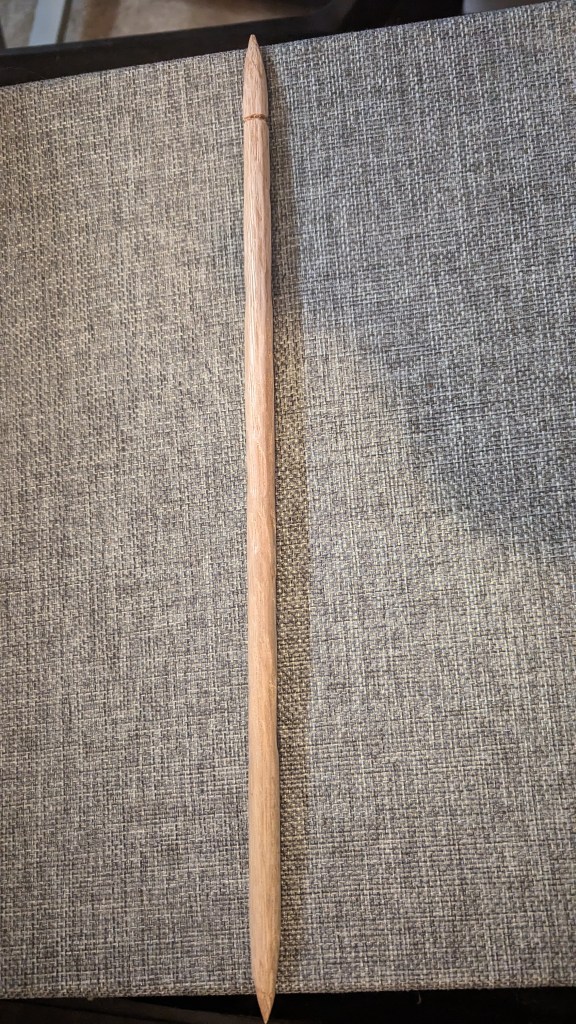
After assembling the spindle, I test-run the spinning with Corriedale wool. Corriedale wool was unavailable in the Slavic territories as it is a New Zealand breed of sheep, but with my skill level for spinning, it is the easiest wool for me to spin.
References
Alpatov, S. V. (n.d.). Birch Barks in the context of folklore and literacy culture. Folklore and Ethnography, 123-128. Retrieved from http://www.drevnyaya.ru/vyp/stat/s4_18_10.pdf
Kochkurkina, S. I., & Orfinskaya, O. B. (2014). Ladoga’s Kurgans culture – Technological textile reasearch. Petrozavodsk: Korelian science center.
Koledinskiy, L. V. (1991). Vitebsk Upper Castle.
Kuzmina, O. V. (n.d.). Women Costumes in XIII cetury. Retrieved from https://slavmoda.com/jenskiy-kostum-xiii-veka/
Lozina-Lozinskya, A. S. (1936). In Flora URSS (pp. 702-704). Kiev: Academy of Sciense USSR .
Nahlik, A. (n.d.). Novgorod Textiles. Research Materials in USSR Archeology, 228-313.
Orfinskaya, M. A. (1997). Ancient Rus. Customs and culture.
Orfinskaya, O. (2020). Old Ladoga Textile during the era of Vikings.
Orfinskaya, O. V., & Engavatova, A. (2009). Medieval textiles from the necropolis of Dmitrov Kremlin, Russia. Archaeological Textiles Newsletters.
Procopius. (VII). History of Wars.
Prohorov, V. (1881). Historical materials about clothes and folk customs. St. Petersburg.
Rybakov, B. A. (1953). After Ancient Cultures: Ancient Rus.
Saburova, M. (1997). Ancient Rus. Customs and culture.
Saburova, M. A. (1997). Ancient Rus costume. Moscow: Science.
Sedov, V. (n.d.). Ancient East Slavic Garb in VI-IX cc.
Sedov, V. V. (1982). Eastern Slavs in Vi-XIII century. Moscow: Science.
Sitdikov, A. G. (2017). The Volga Region Archeology. Tatarstan.
Štih, P. (2010). V. Wiped Out By The Slavic Settlement? The Issue Of Continuity Between Antiquity And The Early Middle Ages In The Slovene Area.
Strekalov, S. (1877). Russian historical Clothes X-XIII century. Saints Petersburg.
Zvelev, N. N. (1996). Flora Europae Orientalis. St. Petersburg, Russia. doi: ISBN 5-90016-28-X
 Phoenix Safe Place