
Rus Noble Woman Outfit and accessories – X-XII century
The following research represents the archeological findings, including examples of visual representation of the period and different archeological resources for Noble Rus female headwear. Even though Rus was not mainly Orthodoxies Christian until 988 (and let’s be honest, even after that), Byzantine significantly influenced the clothes, accessories, and arts through trading and diplomatic relationships with Kyiv and Novgorod. The ancient Eastern Slavic costume, as an ensemble consisting of sewn clothes, a headdress, and shoes, has not been sufficiently covered in scientific literature. The degree of knowledge of its parts is different. Researchers recently turned to pictures, miniatures, and written monuments to reconstruct clothes, relying on them as the primary source. Different materials, methodologies, and cultural phenomena can be traced both ways.
No secret trading and politics also influence the richness of the culture. Eastern Slavs, united as Rus, was heavily involved in trading with Arabs, China, Northern Europe, and Byzantine for centuries. As a matter of fact, one of the most important cities, Novgorod, was built mainly because it was on the crossing of the trade ways. This is why during the archeological expeditions, the burials may contain Chinese silk, arab beads, and Viking-styled pendants.
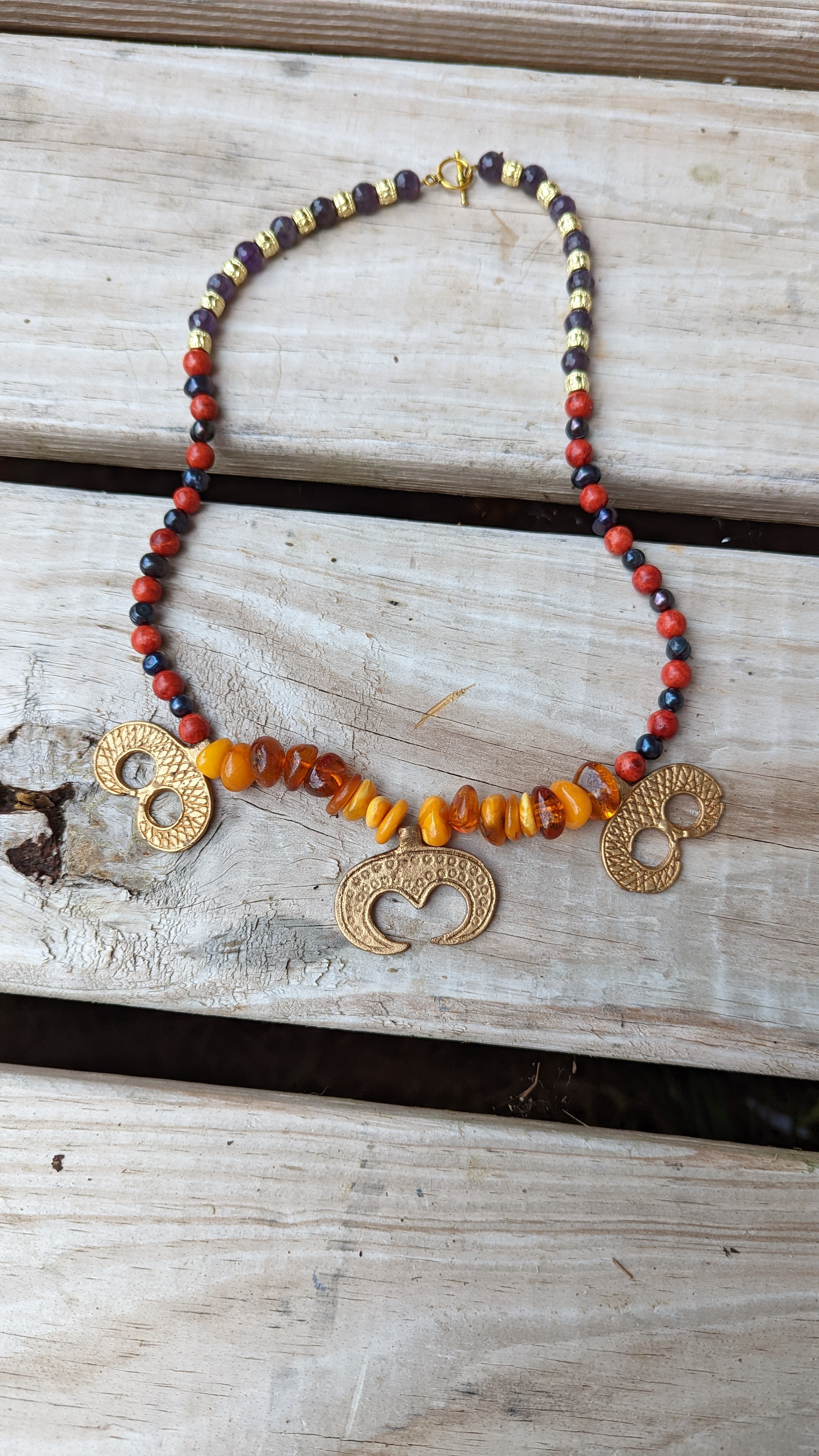
Necklace
Research.
Some of the stones used in this necklace were selected due to the color selection. Those specific semiprecious stones were not located in the archeological findings but could have been bought from Byzantine and Arabic traders. The most commonly seen on the Eastern Slavs’ territory Slavs are Amber, Mountain cristal, Agate, carnelian, lapis, coral, etc.
Silver and gold beads, pendants, clay beads, and stones were often mixed and matched in the necklaces found in burials.

Smolenski treasures. VIII-XII century.
Archeologists often found Crescent pendants in West Slav and East Slavs territory, Roman Empire burials, and even Mesopotamia. Many were found in Christian Byzantine, and the theory is that the Byzantines adopted this motive despite the pagan meanings. The fact that the Byzantine church adopted clearly pagan jewelry helped the Lunnitsa to survive the Christianization of the Rus, and it continued to use in the attire.
The crescent (lunnitsa) brass pendants used in the necklace I made were graciously made and donated by Sir Vilhjelm Viga Gulti (Battle Boar). The pendants were made by sand casting technique where the design piece (made out of stone, metal, wood, or clay) and the mold were made due to sand patting around the area. Once the design piece is removed, the hot liquid metal is poured into the mold, and due to the lower temperature, the metal does hard and takes the shape of the mold. This is one of the period ways to make a piece of jewelry. Once the metal piece is removed from the mold, the piece is cleaned and polished. The hole is made with a power drill and then done and ready.
Tools and materials.
- natural stones – coral, amethyst, and amber
- brass hook
- brass Luna pendant
- Gold beads
- Metal cord
- Metal weaving tool set.
Methodology.
This necklace is simply done by putting beads one after another on the thread.
Ubrus

Research.
Ubrus (or similar items) is an element of the head assembly that every married woman should have worn in Slavic cultures. Ubrus is a towel or a veil worn on its own, held by a trim, kokoshnik, or under the hat with embroidery and fur.
Ubrus could be plain or colored with embroidery. Most of the time, the material used is Linen or silk.
There are plenty of ways to style the ubrus, and one of them is to have one end over the shoulder.
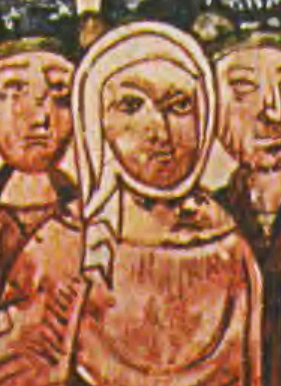
Svyatoslav Wife’s ubrus. 1073
Materials and tools.
- Linen, natural color
- Grey linen thread
- Red linen thread
- Freshwater pearls
- White silk thread
Methodology
I have selected wide natural linen fabric and cut a yard and a half. After the fabric was washed and ironed, I forded the edges and ran run stand ch to hem with grey linen thread. After that, I added some embroidery and red Linen on the long edges by running the stand on the short side, proceeded with a fishbone stitch, and later added fresh-water pearls in “train” less.”
Headwear
Research
In female burials, hats are represented by fragments of textiles, including woolen, silk fabric, and rarely fabrics from filaments of plant origin. Known for felt and organic decay under testable origin (fur), Often also find twisted yarn and fringe of wool, as well as a variety of woolen ribbons, silk, and gold-woven. In addition to tapes from textiles, metal ribbons of silver, bronze, and alloys.
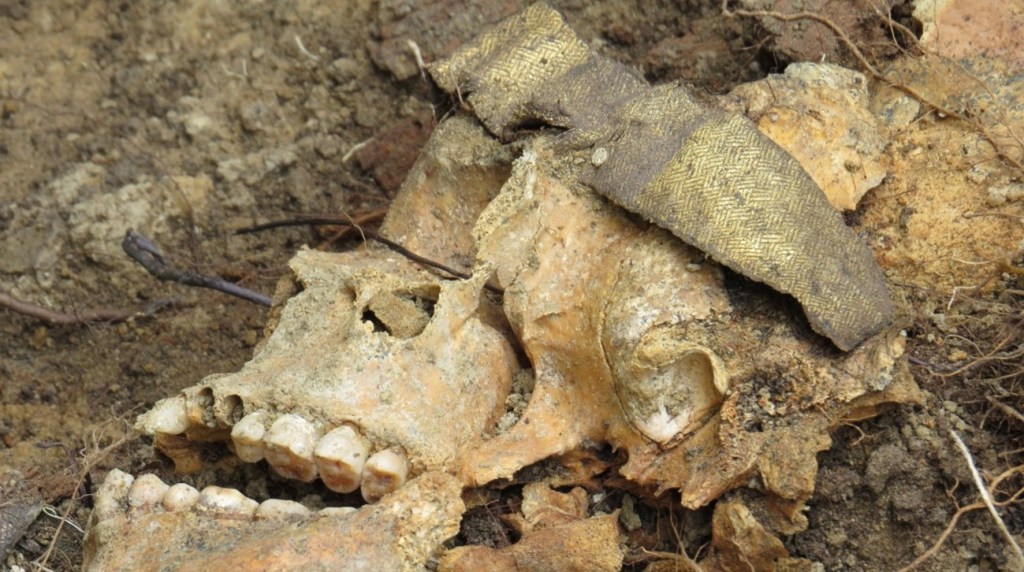
Fragments of the fabric headwear with gold embroidery, approx. XII-XIII century.
Hats are “kokoshniks” decorated with “plaques or embroidered with beads and pearls. In reality, ns and kokoshnik, tiaras etc. Were strictly ceremonial wear. Among complicated hats, the hat consists of fabrics known as a solid base (birch bark, bast, leather) and tin-lead plates. Their common form was a tall hat with the shape of a “halo” ” or a kokoshnik with a rounded top. It was covered with plaques to the top. Such hats were found in the Vologda Oblast (Saburova M.A.,1974.)
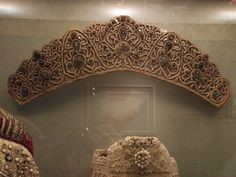
Kokoshnik and beaded embroidery installation. Kyiv Museum.
In the Kharlapovsky burial ground of the Smolensk region, the construction of these Kokoshniks included bracelet-shaped temporal rings attached or superimposed on a birch bark circle. The diameter of birch bark circles repeats the width of the rings. Studies have shown that along the edge of birch, bark circles went holes from punctures with a needle as they were sheathed in red woolen cloth. The rings were attached to the headpiece using leather straps. Perhaps birch bark circles were sewn to rings or just “poked” unde” the headgear, which is known from later materials ethnography.
The materials found in Kharlapov suggest that on both sides of the female headdress, they wore not just rings but blades rounded in shape, also known from the materials of ethnography of the XIX-XX centuries.
Obviously, the kokoshnik structure and materials are expensive, and the amount of work included in the production is not for everyone. Only noble families could allow themselves to purchase this accessory. Mostly stones and materials were purchased from Byzantine, china, and Vikings. Amethysts, crystals, and agates were the most common stones used in jewelry and embroidery. Besides, amber is one of the most significant resources in East Europe. Important to understand that sea and freshwater amber has different quality and colors due to the water quality. Seawater amber is more crystalized, while freshwater amber has a “dusty” color and is not as strong as seawater amber.
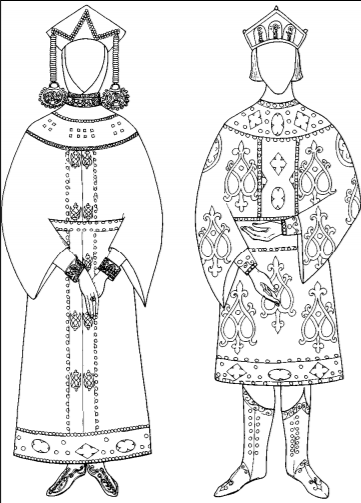
Reconstruction of a Nobel costume (by M. A. Saburova)
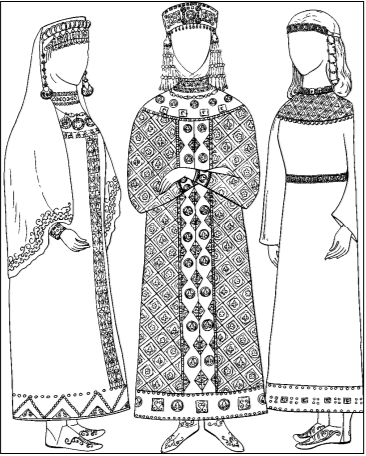
Noblewoman costume reconstruction (by M. A. Saburova).
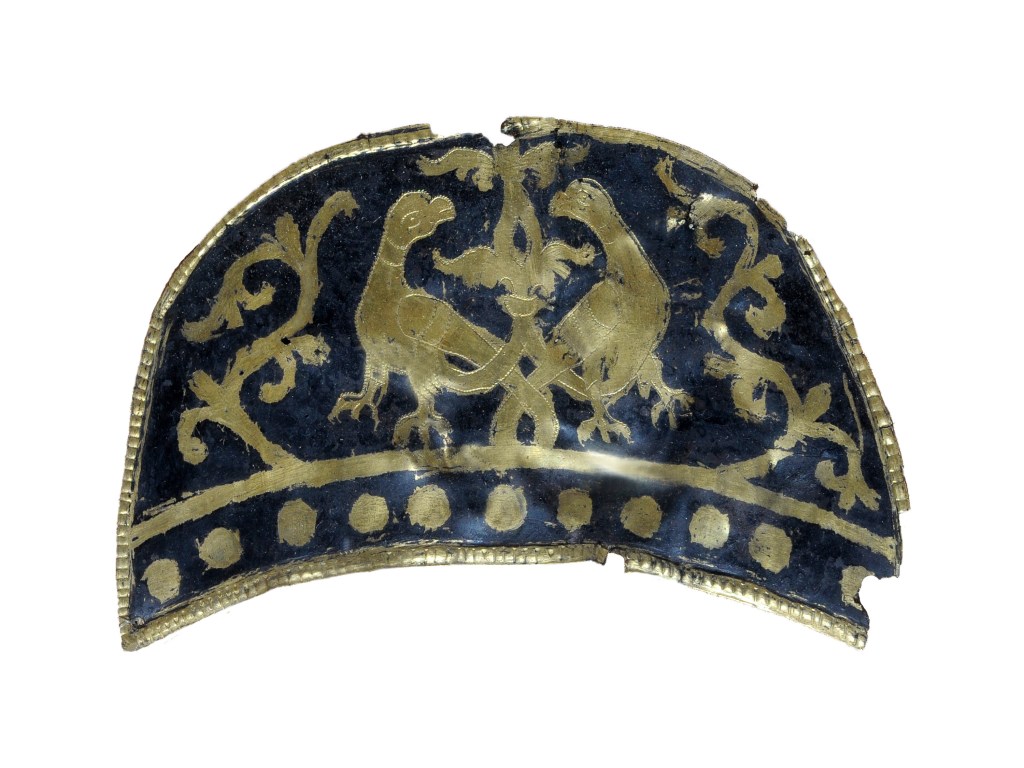
Headwear metal (brass) plaque. Approx. XII century. Vladimiro-Suzdal
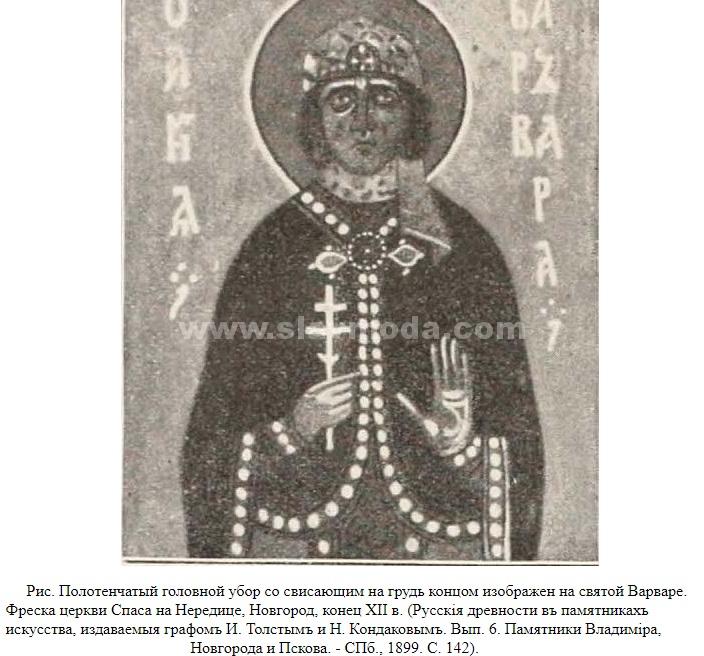
Saint Varvara. XII century. Plaque and embroidery headwear.
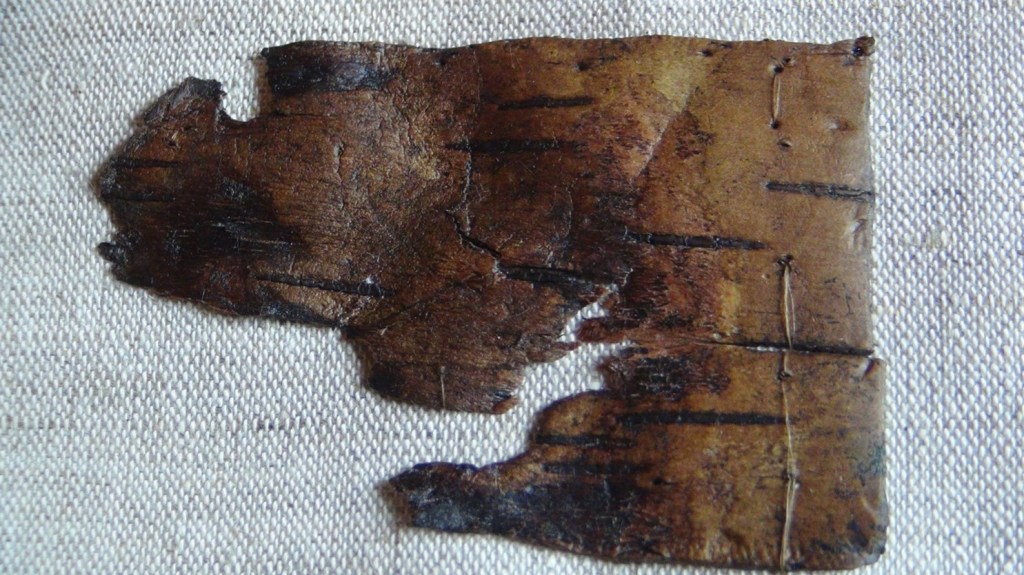
Birch bark is found in the burial as a supporting material for the neckline. Approx. XII century.
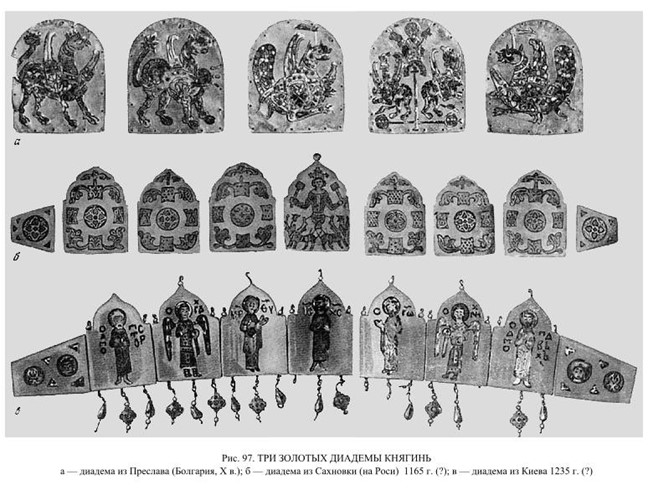
Plaques tiaras. X-XIII century. Rus.
Materials and Tools Used for Headwear
- Red Chinese silk for the main base
- Silver and gold silk threads for embroidery
- Red silk ribbon
- Leather (hard base for the headdress)
- Hoops
- Seed bead needles (size 10/12)
- Red cotton thread to connect the back and front of the headwear
- Pink sea pearls
- Black see pearls
- White sea pearls
- White fresh-water pearls
- Seed beads side 10/0 and 11/0 (silver, rose gold, yellow gold, pearl)
- Seed beads size 15/0 (pearl, silver, yellow gold)
- Gold thread for gold-work.
Technology
I didn’t use the same material and technique to reproduce the exact headwear. That was not my goal, to be quite honest. My goal was to make as close a reproduction as possible by using modern tools, materials, and techniques. Modern seed beads are more even because even though the primary technology did not change much, the cutting tools and machinery now let manufacturers cut beads of different sizes and forms more evenly. That’s why when we look at the period seed bead embroidery, it does not look even at all, and the elements may be a different size. Also, the technologies and modern tools let us use smaller seed beads to replicate the metalwork that initially would be sewn to the material.
In addition, I used gold work to fill in the big sport, using the stem stitch to make the headwear lighter and more wearable. Goldwork, as presented above, is another period technique used to decorate headwear.
Below are the designs that I used in my work. The whole headwear was designed to look like plaques tiaras presented in my research, and I used a big blue brass plate as my central piece inspiration.
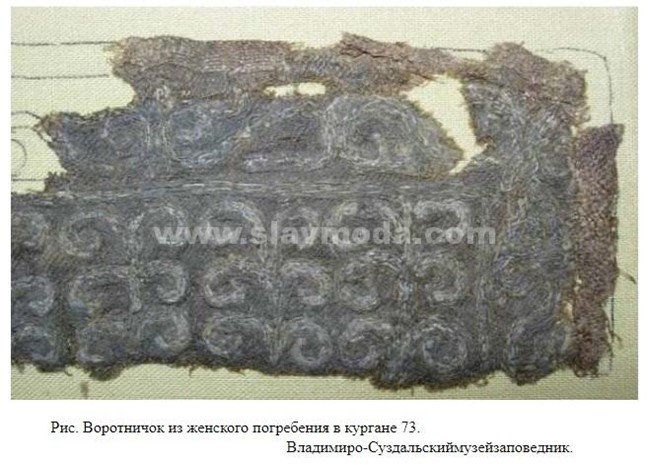
Tree elements embroidery.
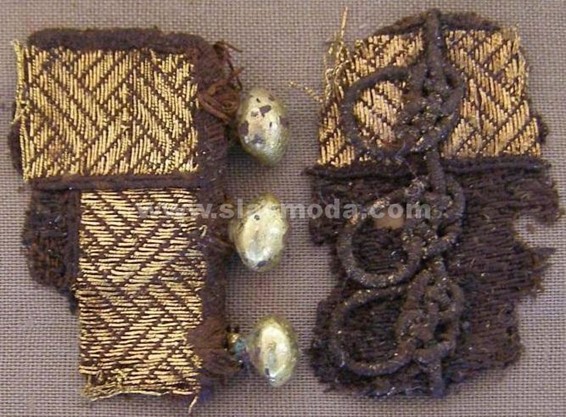
Goldwork sample on the woman’s clothes. Approx. XII century.
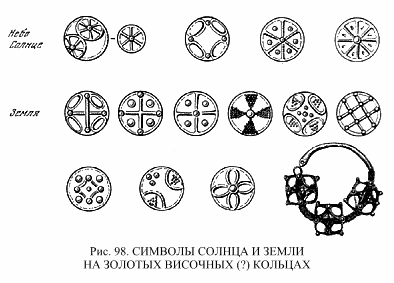
Solar and Earth signs are used in jewelry, embroidery, and carving.
Headwear (the piece in progress)

Once silk was selected, I set it up on the square hoops.
I drafted my design on paper and attached it to the silk for a better transfer. I embroidered the outlines with various seed beads using silk thread and vax to strengthen the thread.
I started with the main outline, filled-in side “plaques,” and then the central piece.
After that, I used my gold thread to fill in big spaces. I used stem stitch, as this is the stitch used in the embroidery items I reviewed.
At last, I fille din pearls attaching them to designated places.
Sawing the pieces together
I have designed the headwear piece to be placed on silk, so I have enough materials around it just to fold the headwear on the flat bottom line and sew the top tother. Once that was complete, I slid the leather piece shaped precisely as headwear and closed the side. As I was the closing side, I sewed in the ribbon so that the headpiece can be held on the head.
Edge of the headwear
After the headwear was sawn together, I ran the line of pearl-colored beads on top to hide the seam where the headwear got connected.
References
Artyuh, D. (2016, October 18). Zebra-TV. Retrieved from https://zebra-tv.ru/novosti/jizn/arkheologicheskie-sensatsii-i-fors-mazhor/
Kuzmina, O. V. (n.d.). Women Costumes in XIII cetury. Retrieved from https://slavmoda.com/jenskiy-kostum-xiii-veka/
Maciej Salamon, M. W. (n.d.). Crescent pendants (lunnitsa) in 11th – 13th century Rus’: Pagan amulet or Christian ornament? Retrieved from http://www.academia.edu/3357505/Crescent_pendants_lunnitsa_in_11th_13th_century_Rus_Pagan_amulet
Orfinskaya, O., & Engavatova, A. (2009). Medieval textiles from the necropolis of Dmitrov Kremlin, Russia. Archaeological Textiles Newsletters.
Prorohov, V. A. (1881). Materials about the rus clothes history and nation livings.
Rybakov, B. A. (1953). After Ancient Cultures: Ancient Rus.
Saburova, M. A. (1997). Ancient Rus costume. Moscow: Science.
Saburova, M. A. (n.d.). Hard necklines and “Ozherelki” in ancient Rus Costume.
Sedov, V. (n.d.). Ancient East Slavic Garb in VI-IX cc.
Sitdikov, A. G. (2017). The Volga Region Archeology. Tatarstan.
Appendix 1. Seed beads embroidery stitches
I used one primary technique for embroidery with beads – the “Stem” stitch.

Probably the one I use the most in my work. If you look at the pattern, it is the same idea as string stitch, but upside down. You should start with two beads, run needs on the wrong side, return needs between two beads, and run it through the last. The embroidery will live forever (well, for a long time with gentle use).
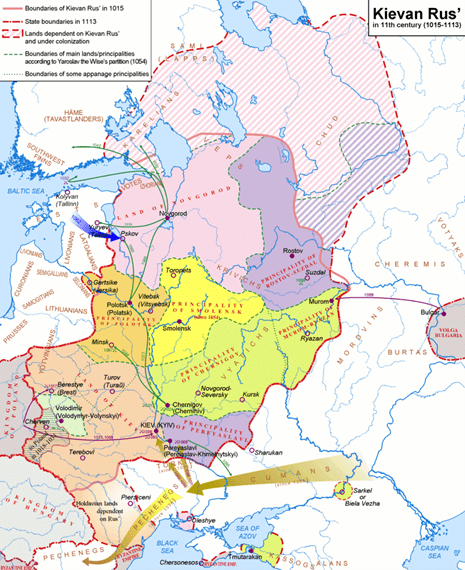
Appendix 2. Kievan Rus map
 Phoenix Safe Place
One thought on “Rus Noble Woman Headwear and accessories”