
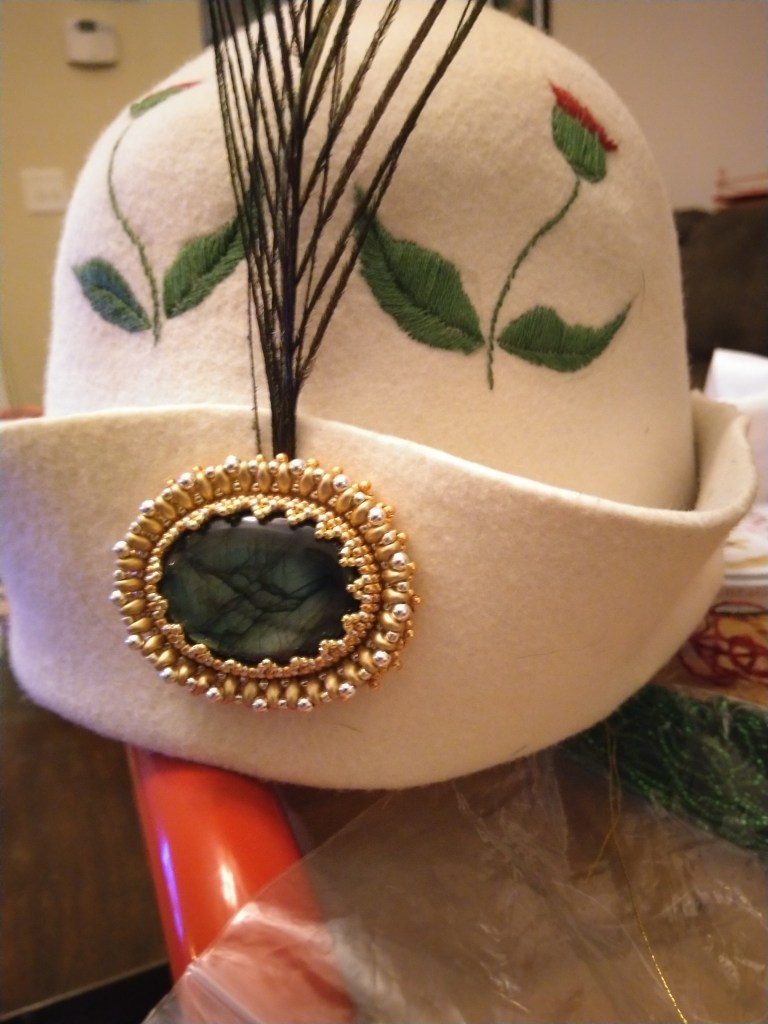
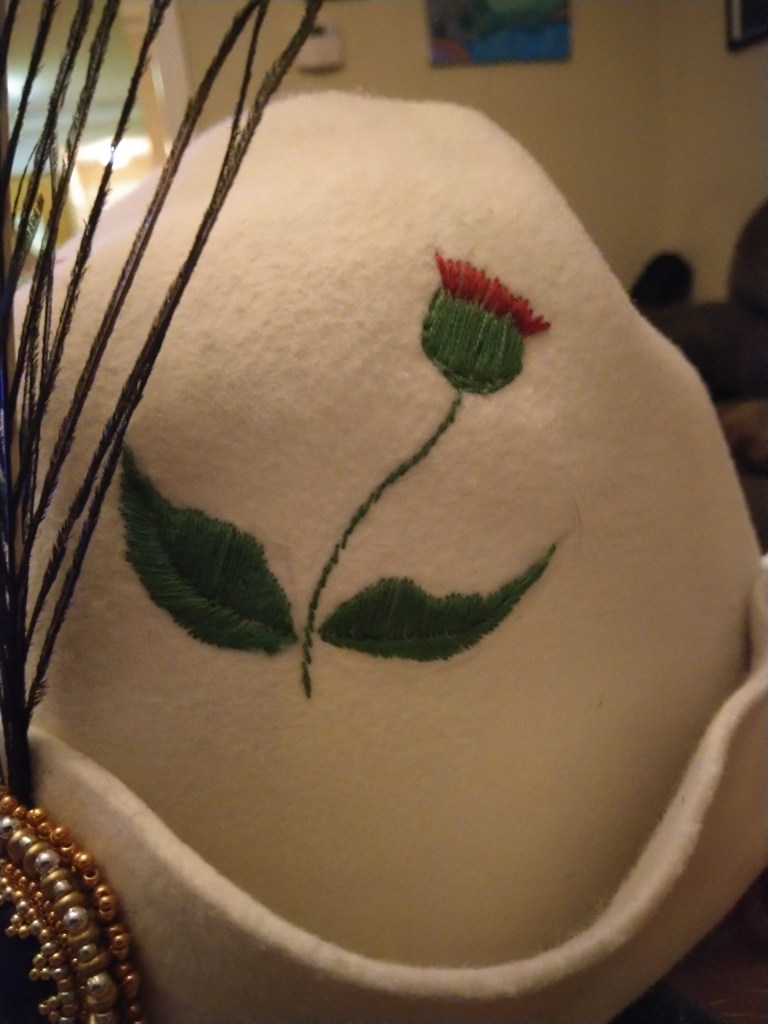
Short Summary
Period: late XV century – early XVI century
Place: Germany
Source of inspiration: Nuremberg’s Schembart Carnival (fig. 1)
Materials used in the original (probably): wool felt, gold, silk ribbon
Materials used in replica: Opal cabochon, Gold and silver seed beads (sizes 11/0, 15/0, 6/0), Duo seed beads, wool, cotton, silk ribbon
My goal was to make as close a reproduction as possible by using modern tools, materials, and techniques.
The presented accessory is the replica of the bucket hat from the portrait of a woman costume from Nuremberg’s Schembart Carnival book illustration (fig.1).
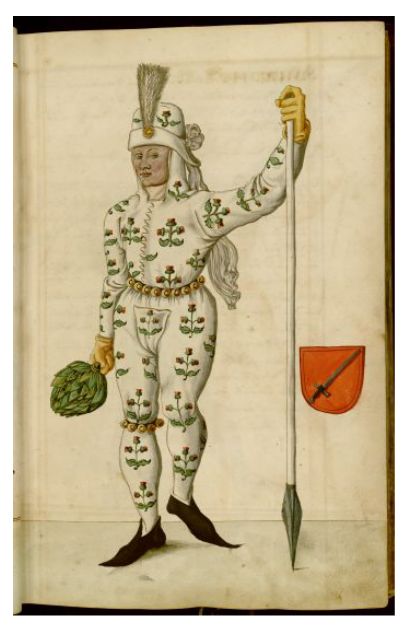
Beginning in 1449, the event was famous throughout the 15th century. Still, it ended in 1539 due to the complaints of an influential preacher named Osiander, who objected to his effigy being paraded on a float, depicting him playing backgammon surrounded by fools and devils. According to legend, the carnival had its roots in dance (a “Zämertanz”) which the butchers of Nuremberg were permitted to hold by the Emperor as a reward for their loyalty amid a trade guild rebellion. Over the years, the event took on a more subversive tone, evolving to let others take part with elaborate costumes displayed and large ships on runners, known as “Hells,” which were paraded through the streets.
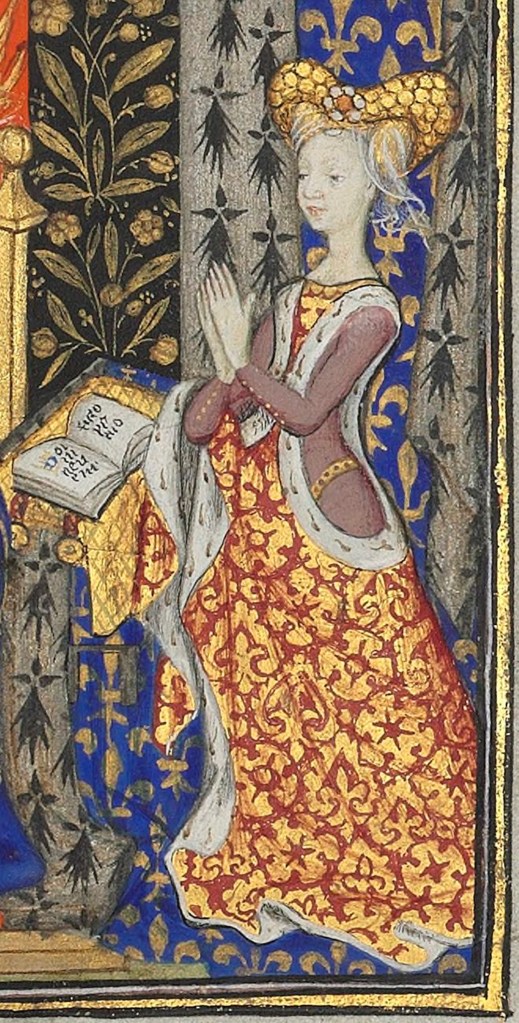
Different portraits from the same time inspired me to create a replica of the central jewel a little differently. There is no other documentation of the accessory or the hat that I could find. However, I found more resources on the headdresses with the accessories on other portraits, which allows me to assume that this accessory was pretty standard within the given period.
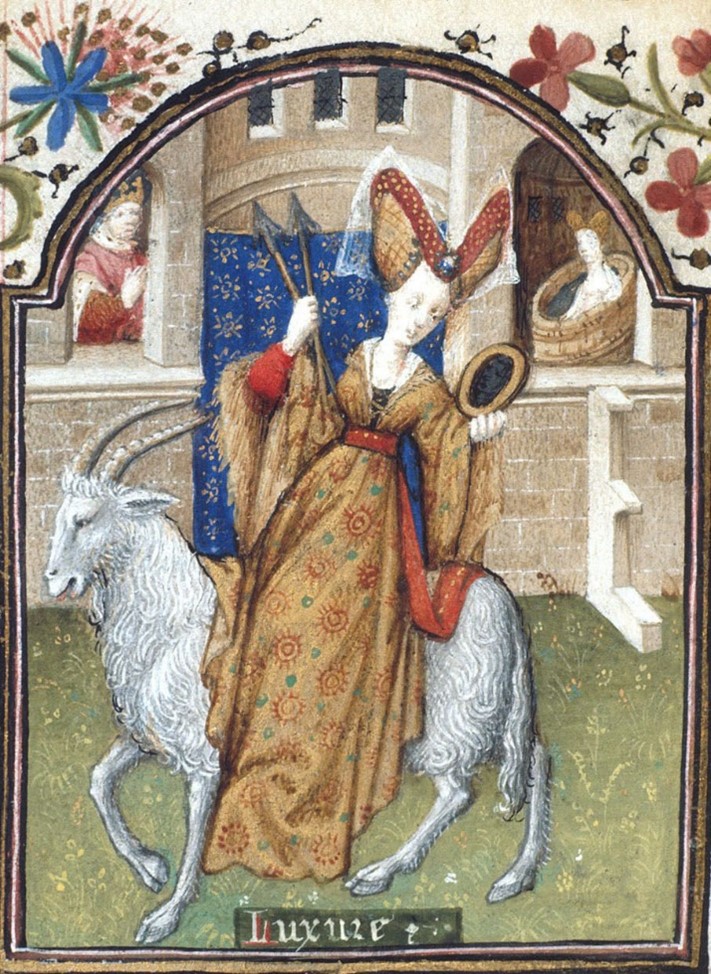
This style was mainly worn in Northern France, Burgundy, and the Low Countries. It was never a current trend in England, Italy, or Spain (Boucher). Several aristocratic female figures of Northern France, Burgundy, and the Low Countries were depicted wearing the heart-shaped bourrelet, like Marguerite de Bavière, who was duchess consort of Burgundy and mother-in-law of Isabella of Portugal (Fig. 1), Marguerite d’Orleans, Countess of Vertus (Northwest France) (Fig. 3) (source: Fashion History).
The research that I have made helped me realize that this accessory was usually used as a sign of nobility. In this case, the accessory usually was made with gems, pearls, and gold. I had no chance to make the replica, so I used some seed bead weaving techniques (appendix 1) to recreate such a beauty.
Now, let’s talk about production. I didn’t use the same material and technique to reproduce the Jewel. That was not my goal, to be quite honest. My goal was to make as close a reproduction as possible by using modern tools, materials, and techniques. So, I have gotten seed beads because they are my passion, and I started playing.
The work was done with a modern needle 12/0 size and golden silk thread. The original stone is probably Ruby (the red color could tell us about coral, but this type is not typical for that period). However, the ruby is very expensive and very rare. I chose opal cabochon instead.
The first step was to attach the cabochon to the felt (neutral color). For this, I used a stem stitch around the stone and then a mosaic stitch to make the clap around it (appendix 1). For this step, I used golden Japanese seed beads size 11/0, and on the last row of mosaic stitch, golden Japanese beads sized 15/0.
Then I added more rows around the stone with decorations using stem stitch. The first row is Japanese seed beads 11/0, gold color; the second consists of Duo seed beads, silver seed beads 11/0 and 6/0 size. The last rows were primarily golden Japanese seed beads 11/0 in size. By doing this, I was trying to imitate the golden decorations around the opal stone.
After I was done with the embroidery, I cut off the piece by the edge and cut the same oval from the black leather. After that, I attached the leather part to the felt using a seaming stitch (appendix 1). For this, I used golden Japanese beads 11/0 size again. This step helped me to make the sides neater plus; now it looks like the jewelry sides on the portrait.
The hat.
Felt use has one of the oldest ways of using wool. Dating back to the Greeks and early Chinese cultures. The process of creating felt is by using the wet felt process. The wet felt process is simple. It takes wool, dampens it with water, and agitates the fibers, which causes it to bind together until the felt is created. Felt amazing is only to be found in use in European and Asian cultures. Felt has been used for a wide variety of things, such as tents, hats, and even armor. Many historians believe that nomadic cultures such as the Mongolians may have never existed without the use of felt. “The question may be raised whether the Romans transmitted the knowledge of felt to the Celtic and Germanic peoples, or in other words, whether
the use of the felt in medieval and modern Europe is a heritage of classical civilization. The Germanic languages have a word for the felt in common: German “filz,” Dutch “vilz,” Danish-Swedish “felt”, and Anglo-Saxon “felt.”
This word is connected by linguists with Old Slavic plus (Laufer, 1930). The hat was attempted to be felted from the sheep wool using different techniques. Then, a simple hat base was formed for the Bycocket hat and fixed by the steamer. Simple hand-stitch embroidery (satin stitch) was added at the end of the formed hat. After all, I attached jewels, silk ribbons, and feathers by the golden threads and English pins.
Resources.
Boucher, François. 20,000 Years of Fashion: The History of Costume and Personal Adornment.
Expanded ed. New York: H.N. Abrams, 1987. http://www.worldcat.org/oclc/990429904.
Brown, Susan, ed. Fashion: The Definitive History of Costume and Style. New York: DK
Publishing, 2012. http://www.worldcat.org/oclc/840417029.
Dib, Nicole Naim. “1450 – Rogier Van Der Weyden, Portrait of Isabella of Portugal.” Fashion
History Timeline, 8 Jan. 2018, fashionhistory.fitnyc.edu/1450-van-der-weyden-isabella/.
LAUFER, B. (1930). THE EARLY HISTORY OF FELT. Retrieved from https://anthrosource.onlinelibrary.wiley.com/doi/pdf/10.1525/aa.1930.32.1.02a00020?fbclid=IwAR0lIBhJ852HjJAkm8LgG1kngsRxVQ6uo09VSwyuVrVRL-1c9HQVCV3Vatc&
New World Encyclopedia. (2017). Felt. Retrieved from http://www.newworldencyclopedia.org/entry/Felt?fbclid=IwAR0OhC0bOxo2dmgsbjcnykCy3wL59T-M3MG9ZJOIJBlZejyBkySTNBs99qQ
 Phoenix Safe Place
One thought on “Schembart Carnival – White Bycocket Hat with hand stitch embroidery and central seed beads embroidered jewel.”