
Short Summary
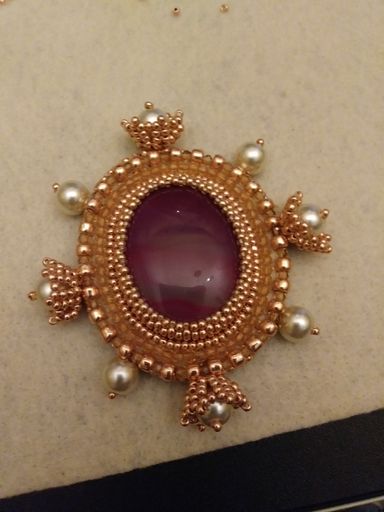
Name: Central Jewel from the Headdress
Period: late XIV century – early XV century
Place: France, Bavaria, Portugal
Source of inspiration: Portrait of Marguerite de Bavière
Materials used in the original (probably): Ruby, gold, pearls
Materials used in replica: Gold Seed beads (sizes 11/0, 15/0, 6/0), pearls, Swarovski crystals.
My goal was to make as close a reproduction as possible by using modern tools, materials, and techniques.
History
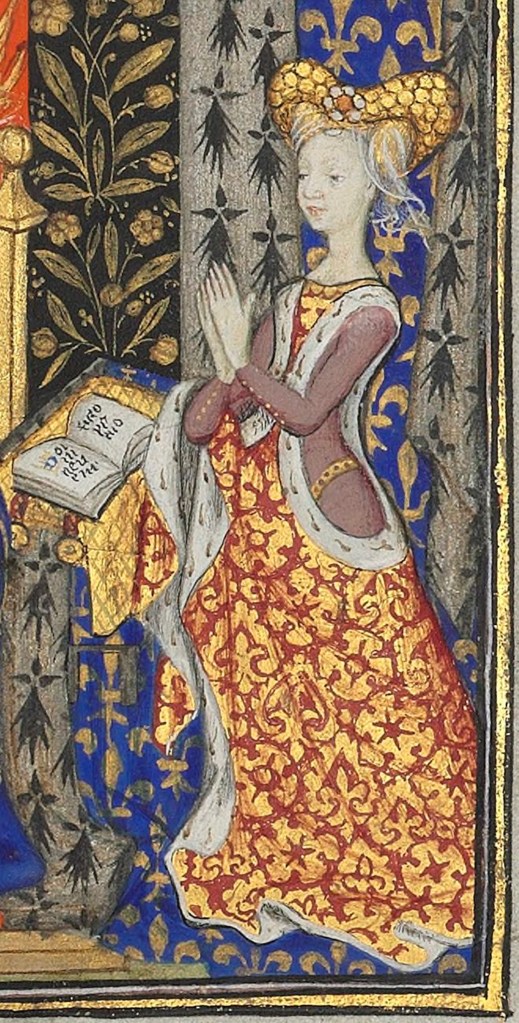
The presented accessory is the replica of the heart-shaped headdress accessory from the portrait of Margaret of Bavaria (1363 – January 1423, Dijon). She was the Duchess consort of Burgundy by marriage to John the Fearless, Duke of Burgundy. She was the regent of the Burgundian Low countries during the absence of her spouse in 1404–1419 and the regent in French Burgundy during the absence of her son in 1419–1423 (Huygens).
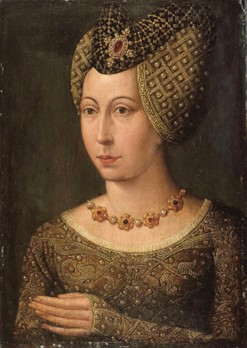
The portrait that inspired me to create the replica was painted after Margaret died. There is no other documentation of the accessory or the hat that I could find. However, I found more resources on the headdresses with the accessories on other portraits, which allows me to assume that this accessory was pretty common within the given period.
For example, Isabella of Portugal wears various accessories in the portrait, including golden rings, a pearl necklace, and a headpiece adorned with jewels: all of which convey her aristocratic status. The headpiece is being used in a crown-like manner.
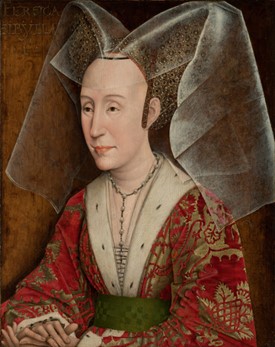
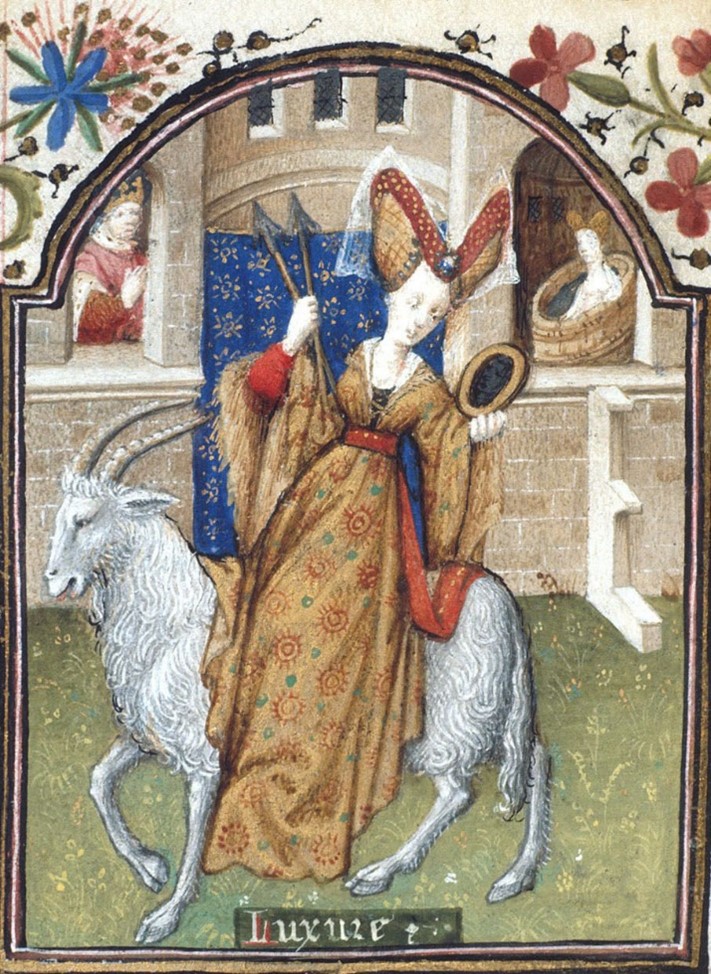
This style was mainly worn in Northern France, Burgundy, and the Low Countries. It was never a current trend in England, Italy, or Spain. Several aristocratic female figures of Northern France, Burgundy, and the Low Countries were depicted wearing the heart-shaped bourrelet, like Marguerite de Bavière, who was duchess consort of Burgundy and mother-in-law of Isabella of Portugal, Marguerite d’Orleans, Countess of Vertus (Northwest France). There are other contemporaneous artworks of this time, manuscripts with paintings, and a French Book of Hours, showing the same style of dress and head-dress worn by Isabella of Portugal and Margaret of Bavaria.
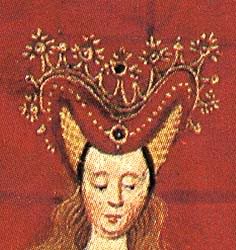
The research that I have made helped me realize that this accessory was usually used as a sign of nobility. In this case, the accessory usually was made with gems, pearls, and gold. I had no chance to make the replica, so I used some seed bead weaving techniques to recreate such beauty.
Production
Now, let’s talk about production. I didn’t use the same material and technique to reproduce the Jewel. That was not my goal, to be quite honest. My goal was to make as close a reproduction as possible by using modern tools, materials, and techniques. So, I got seed beads because they are my passion and started playing.
The whole work was done with modern needle 12/0 size and golden nylon thread. The original stone is probably Ruby (red color could tell us about coral, but this type is not typical for that period). However, ruby is very expensive and very rare. I chose the amethyst cabochon instead.
The first step was to attach the cabochon to the felt (neutral color). For this, I used a stem stitch around the stone and then a mosaic stitch to make the clap around it (appendix 1). For this step, I used golden Japanese seed beads size 11/0, and on the last row of mosaic stitch, golden Japanese beads sized 15/0.
Then I added more rows around the stone with decorations using stem stitch. The first row is Japanese seed beads 11/0, gold color; the second consists of Swarovski crystals; the last is Swarovski crystals and golden Japanese seed beads 6/0 size. By doing this, I was trying to imitate the golden decorations around the ruby stone.
After I was done with the embroidery, I cut off the piece by the edge and cut the same oval from the black leather. After that, I attached the leather part to the felt using a seaming stitch (appendix 1). For this, I used golden Japanese beads 11/0 size again. This step helped me to make the sides neater plus, now it looks like the jewelry sides on the portrait.
The third step is to make four “cups” for pearls. The Ndebele technique is perfect for this (appendix 2). I decided to make four rows, so the pearls would fit perfectly in them. I used golden Japanese beads in 11/0 size. Then I attached the cups with the pearls inside. In the final step, I attached the last four pearls on the side. Done.
Refferences
Boucher, François. 20,000 Years of Fashion: The History of Costume and Personal Adornment.
Expanded ed. New York: H.N. Abrams, 1987. http://www.worldcat.org/oclc/990429904.
Brown, Susan, ed. Fashion: The Definitive History of Costume and Style. New York: DK
Publishing, 2012. http://www.worldcat.org/oclc/840417029.
Dib, Nicole Naim. “1450 – Rogier Van Der Weyden, Portrait of Isabella of Portugal.” Fashion
History Timeline, 8 Jan. 2018, fashionhistory.fitnyc.edu/1450-van-der-weyden-isabella/.
Leeuwen-Canneman, DjrMieke van. “Digitaal Vrouwenlexicon Van Nederland.” Resources, Instituut Voor Nederlandse Geschiedenis, 18 Jan. 2018, resources.huygens.knaw.nl/vrouwenlexicon/lemmata/data/MargarethaVanBeieren.
 Phoenix Safe Place
One thought on “The central heart-shaped head accessory replica”