
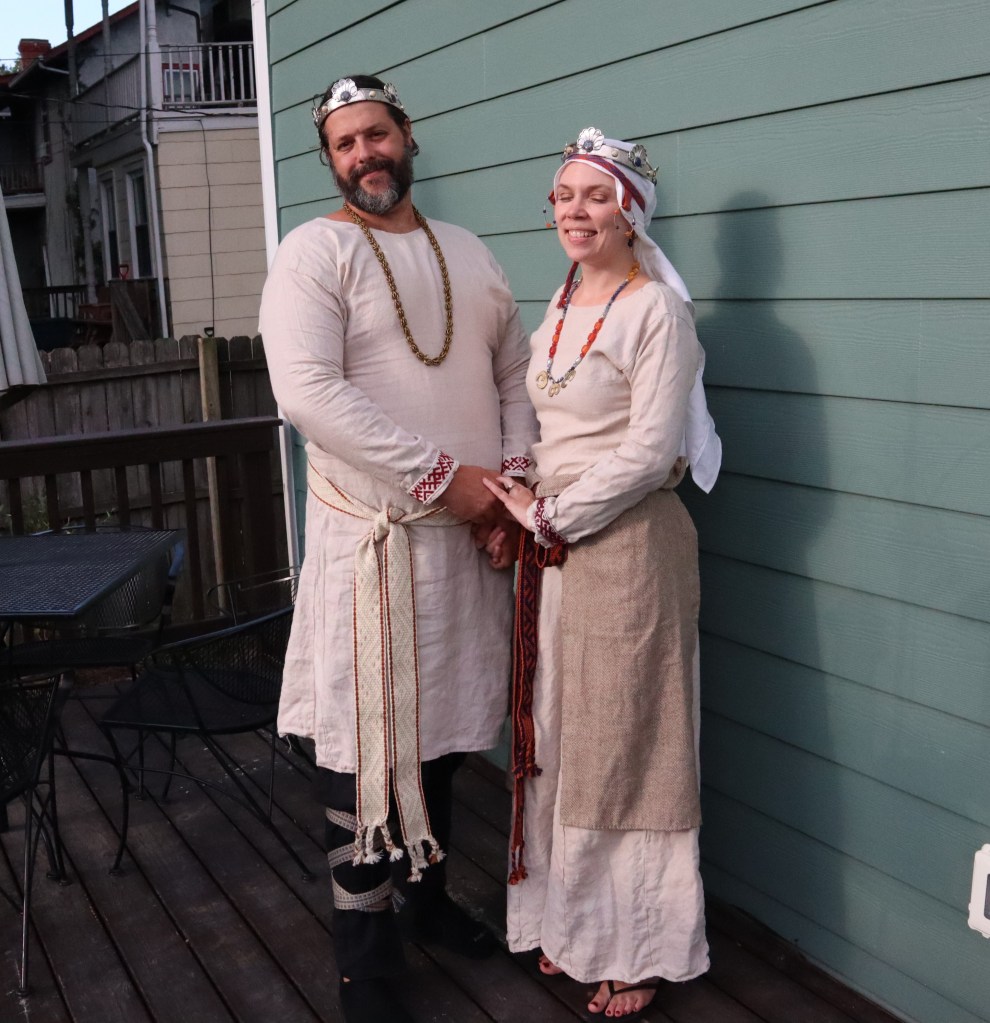
Let me introduce you to the background of this project. This garb was a part of one big project, where within a month, I was tasked to make 4 pairs of garb for an amazing couple. When we discussed the plan and the outfits, I could not resists and threw the Rus-themed garb in the pot because:
- Slavic garb and accessories are absolutely beautiful on any body type
- I know exactly what I am doing
- It is easy to wear, and with the right material, it is light during the summer event
Overall, I have made:
- woman tunic
- man tunic
- rus style pants
- paneva skirt
- Necklace
- Headband and temple rings
- Belt
- trim
I would like to start with the accessories.
Accessories
Necklace
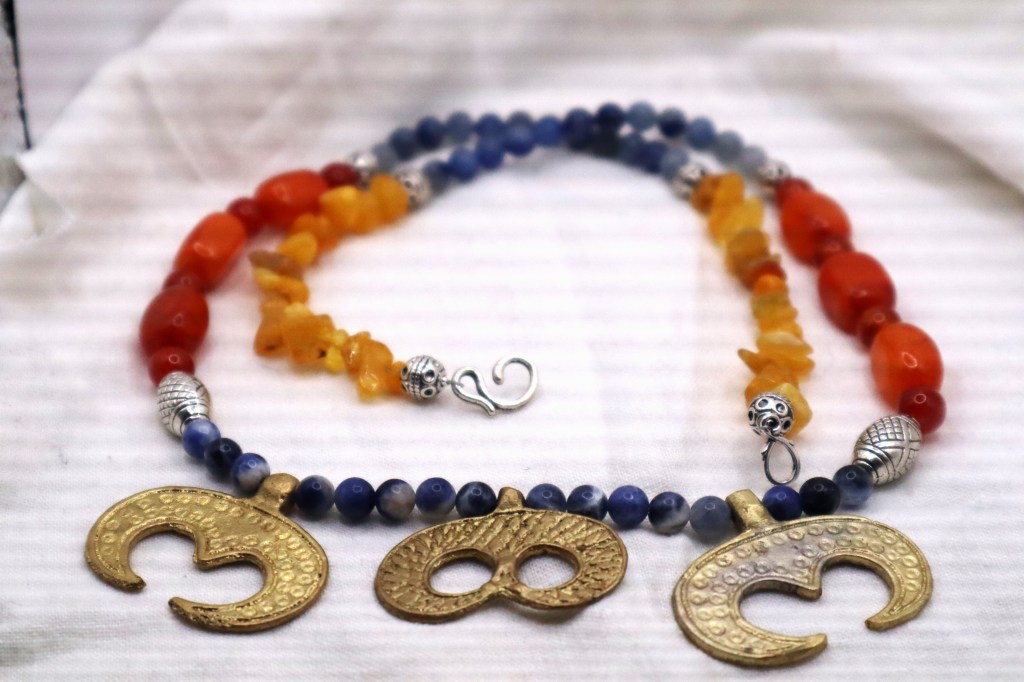

Material used
- natural stones – Lapis, Sodalite, yellow agate, orange agate
- brass hook
- brass Luna pendants
- silver beads
Some of the stones that were used in this necklace were selected due to the color selection. those specific semiprecious stones were not located in the archeological findings but could have been bought from Byzantine and Arabic traders. The most common stones that were used on the territory of the Eastern Slavs are Amber, Mountain cristal, Agate, carnelian, Lapis, coral, etc.
Silver beads, pendants, clay beads, and stones were often mixed and matched in the necklaces found in burials.
Crescent pendants were often found by archeologists in West Slavs and East Slavs territory, but also in Roman Empire burials and even Mesapothmian. Many were found in Christian Byzantine and the theory is that this motive was adopted by the Byzantine despite the pagan meanings. The fact that the Byzantine church adopted clearly pagan jewelry helped the Lunnitsa to survive the Christianization of the Rus and it continued to use in the attire.
The crescent (lunnitsa) brass pendants that were used in the necklace I made were graciously made and donated by Sir Vilhjelm Viga Gulti (Battle Boar). The pendants were made by sand casting technique where the design piece (made out of stone, metal, wood, or clay) and the mold were made due to sand patting around the area. Once the design piece is removed, the liquid hot metal is poured into the mold and due to the lower temperature, the metal does hard and takes the shape of the mold. This is one of the period ways to make a piece of jewelry. Once the metal piece is removed from the mold, the piece is cleaned and polished. The hole is made with a power drill and then done and ready.
This necklace is simply done by putting beads one after another on the thread.
Temple rings
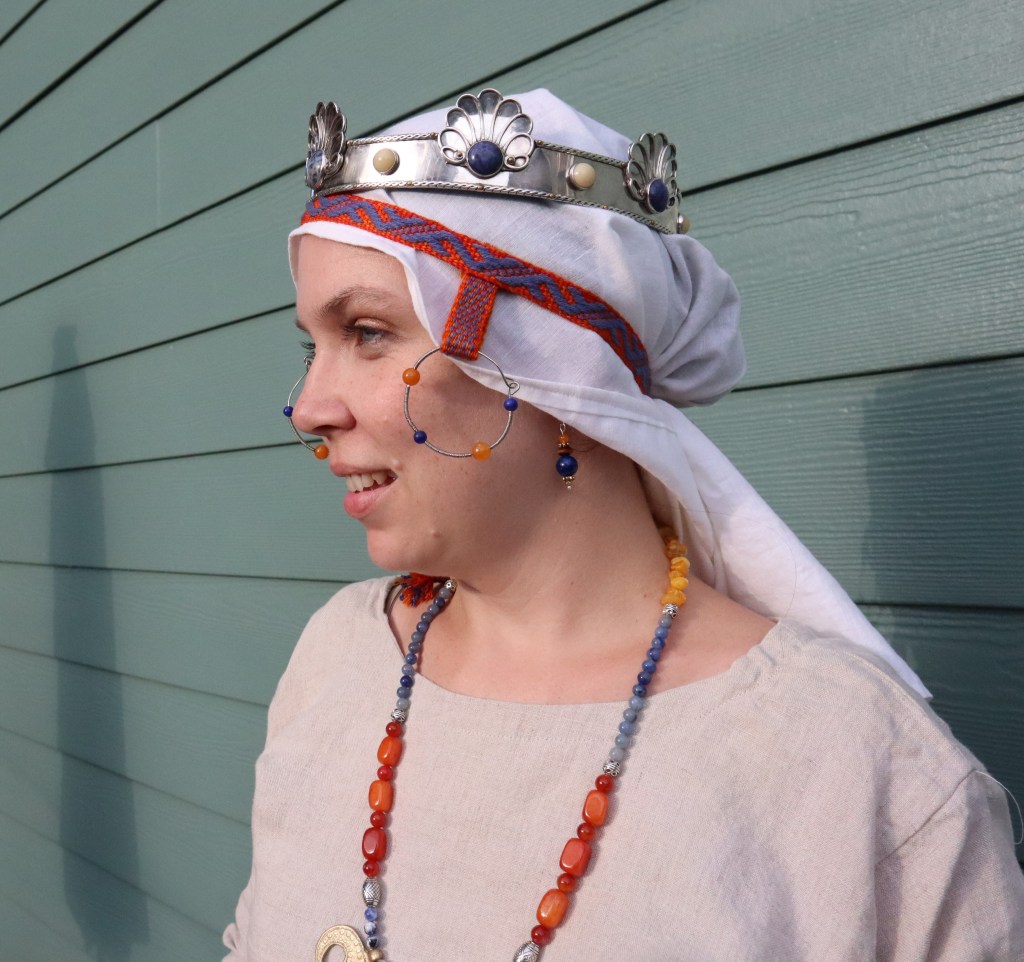
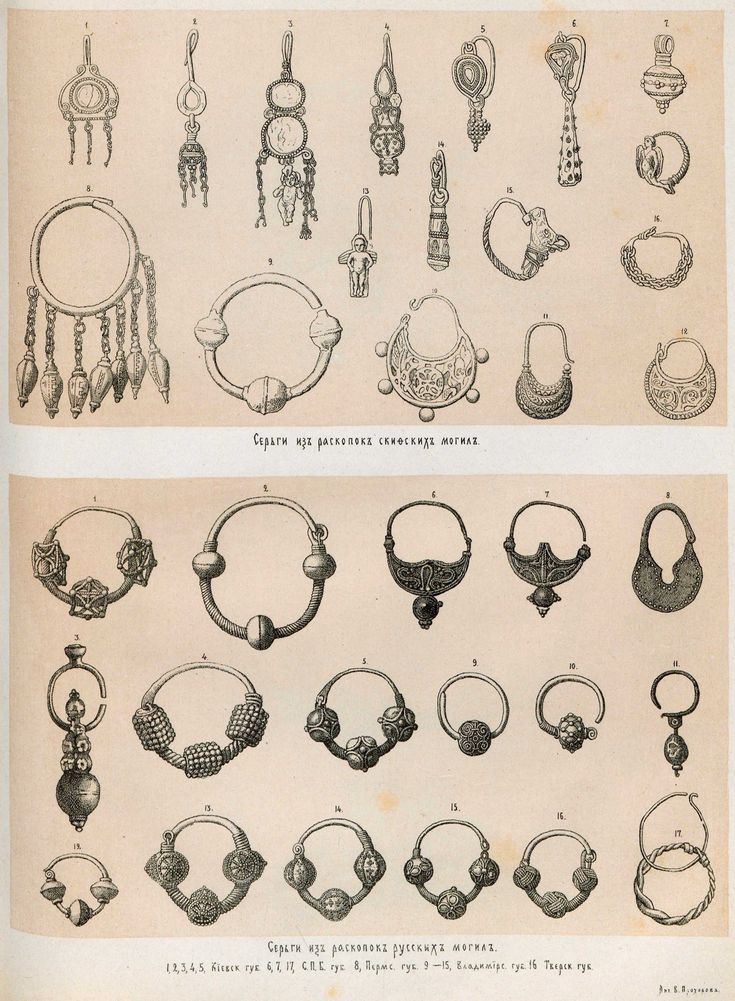
Temple rings were designed based on the design of Prorohov materials.
I have decided to replace metal elements with beads. The 18g silver wire was selected as a base, and the 25g wire was selected as “find the word” to weave around the base. I simply took a round object ( I believe it was a washing tape roll, bent the temple ring base, and then weaved the wire around the main, placing the stones in places. Once one temple ring was done, I measured the second temple ring against it to make sure they were equal.
Upon completion, I attached the temple rings to the headband, putting them through two little loops on the temples.
Belt and the headband
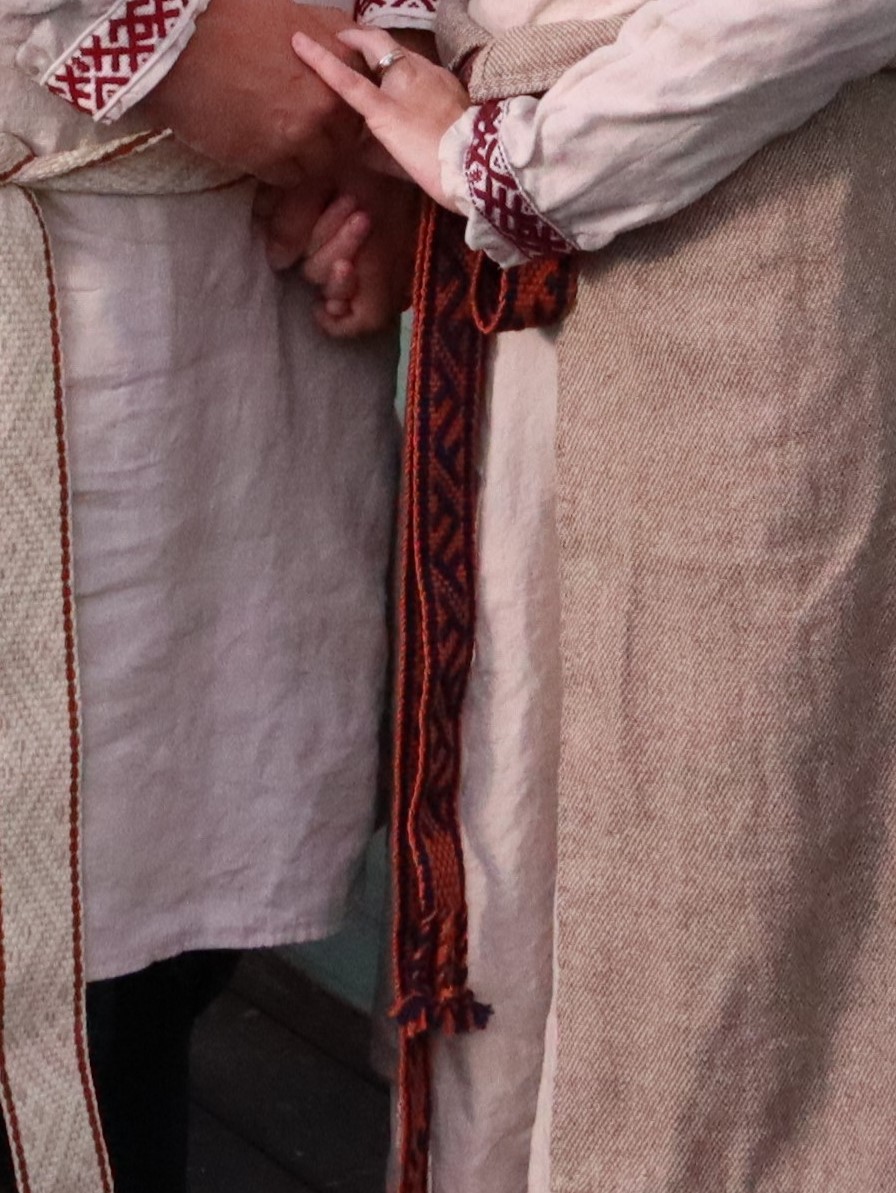
Both belt and the headbands are done using the baltic weaving technique using the same design with the only difference in material selection.
For the belt, I used new wool in rust color for the base and dark blue color for the pattern.
For the headband, I used blue cotton and orange wool that was hand died by the merchant, however, I have no knowledge of the dye that was used. I did not use new wool or any rough material to avoid any irritation on the face skin. In history, silk, linen, or light wool could been used instead of cotton.
I set up the medium inkle loom and used its full potential for the length (around 4 yards), and for the headband I used half of it.
Trim
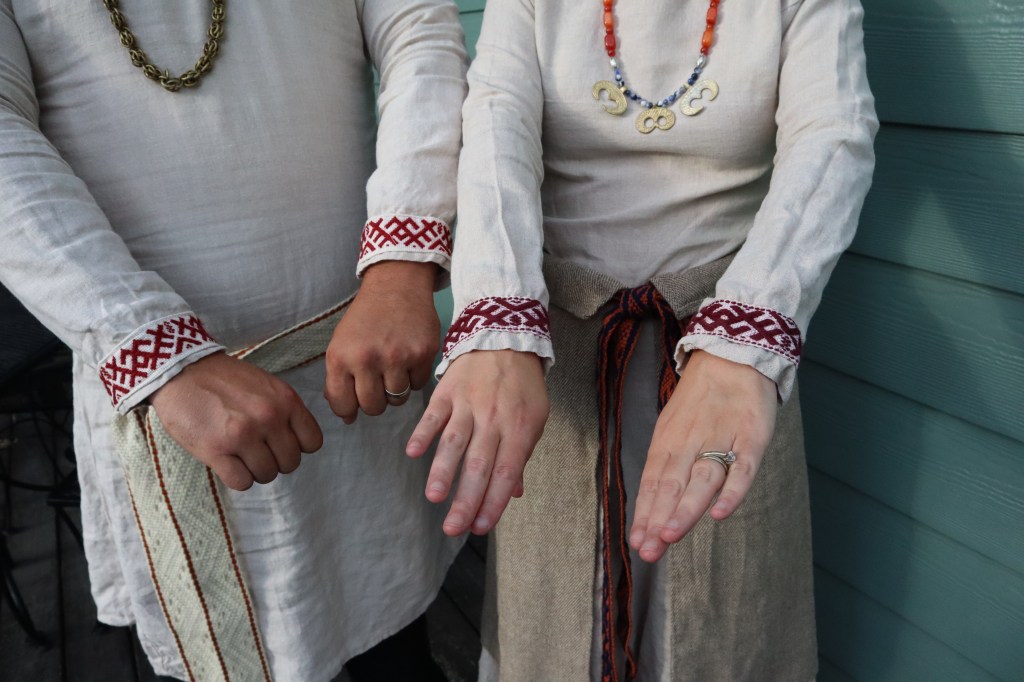
Oh, let me tell you about this trim. This was a battle I lost. The design was made based on the textile findings and embroidery and weaving designs from the 9-11 century Rus.

The original idea was to make 12-15 yards of trim on the big Inkle loom I have in my possession with a baltic weaving technique. I selected the material of dark red wool for the pattern and silky cotton for the base. Overall the pattern had 18 threads for the pattern itself.
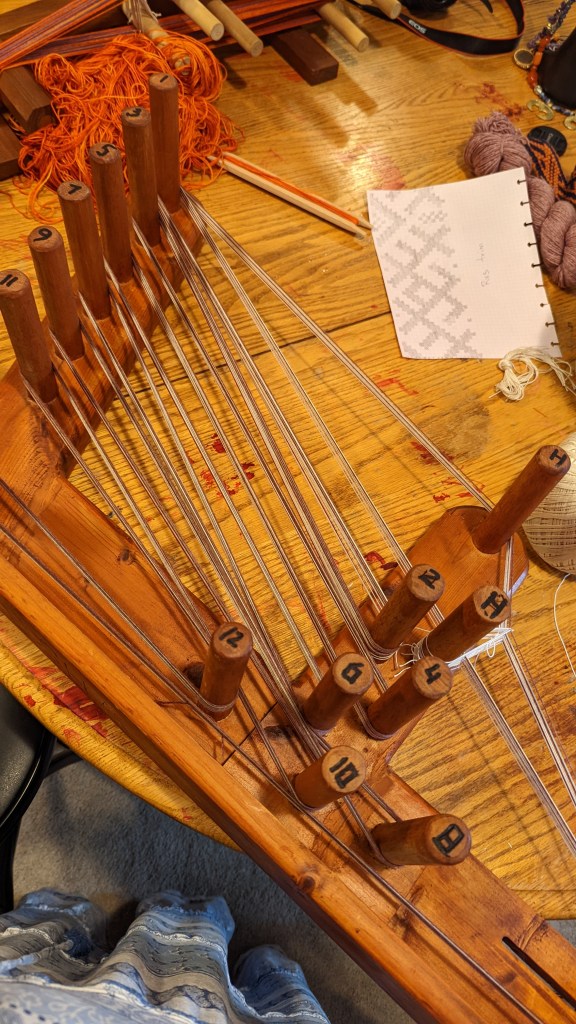
Once I set up the loom and started weaving – I found a mistake in the middle of my setup. After the loom was reset and the first pattern was weaved, I needed to move the pattern and the middle thread just ripped. after this constant battle, I gave up and went for a different material – I went with cotton instead of new wool for the pattern sticking to the same color.
For the third time, I managed to get 25 inches of trim from the loom until the threads were ripped again.
25 inches was just enough to put on the sleeves of one tunic. I was determined to get theme matching but did not have the time and resources to restart weaving.
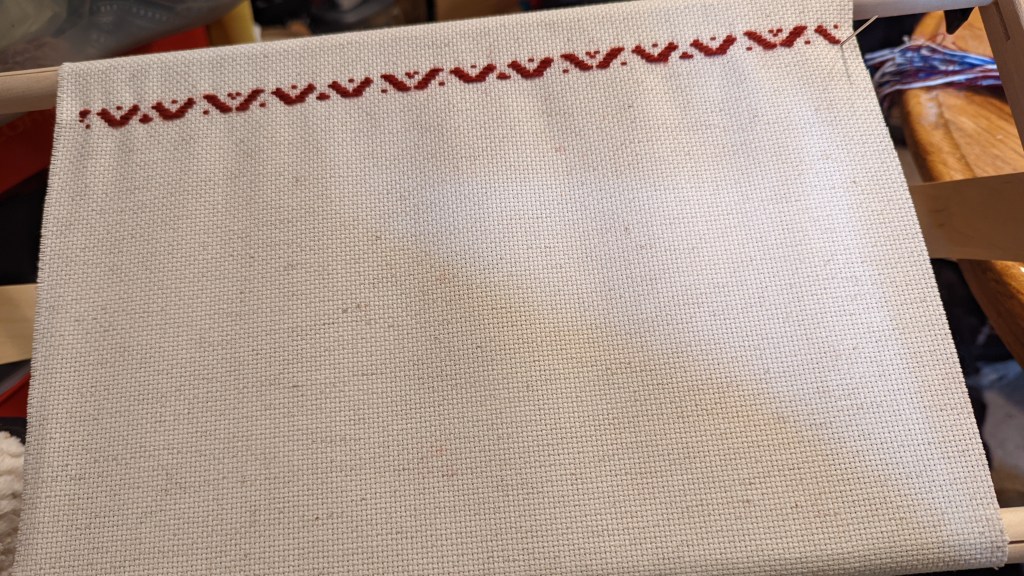
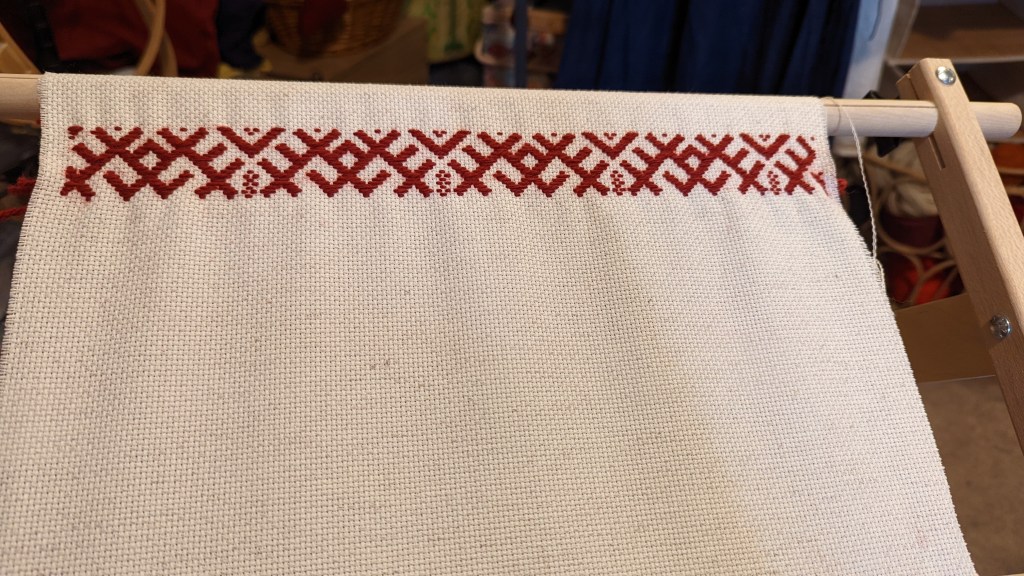
My tired and frustrated brain came up with a solution quite radical. A year ago, I made two towels for the knighting ceremony, one of them used running stitch embroidery to imitate a weaving pattern towel. BINGO, I said and set up my embroidery. I used cotton AIDA, counted 18, and selected the new wool color Bordo. I used the same pattern for the running stitch, and it looked quite close to the woven trim I made on the loom. I would say I have done my best out of the unfortunate situation.
Clothes
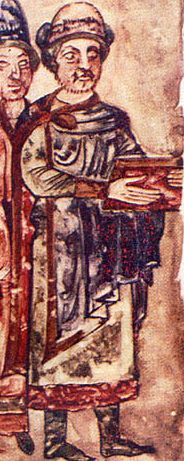

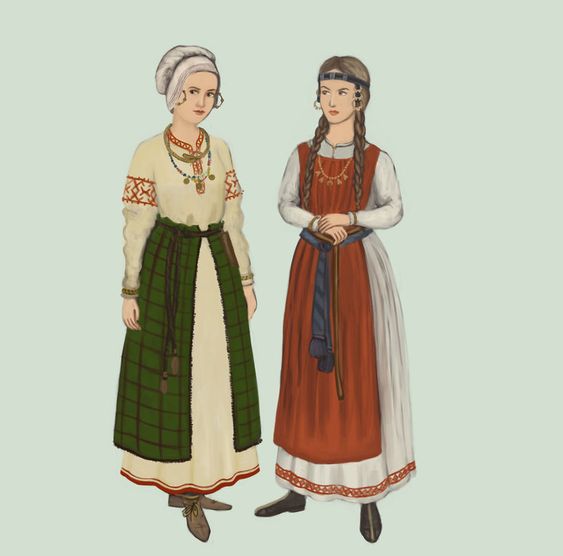
Let’s talk about some clothes. The clothes were made based on the Saburova reconstruction and different archeological findings and visual reconstructions based on the miniatures from period resources. technically, it is what we call t-tunic with gores.
For both, woman’s tunics, I used natural color linen on a heavy side. the pattern I used was the same. The only difference was the length and I added the trim on the sleeves.
The tunics and rus pants were sewn on the machine due to time limitations and hemmed using the serger using cotton threads of the same color.
Panel skirt is the skirt that was used, but plenty of tribes and oh mine, I know why. It is so multi-functional, yet elegant and light. Paneva skirt is two pieces of wool held together by the belt. the halves can reside on the hips or front and the back like an apron. I used manufactured wool donated by NAME and simply cut out two rectangular which were hand hammed by folding the edge and sewing throw with a running stitch (linen natural color thread).
Headwear was made out of light white linen using the same methodology as a paneva skirt.
It sounds simple, but yet, in assembly, it is quite pretty.
references:
V. A. Prohorof. Materials about the rus clothes history and nation livings. 1881. http://tehne.com/event/arhivsyachina/v-prohorov-materialy-po-istorii-russkih-odezhd-i-obstanovki-zhizni-narodnoy-vypusk-1-y-1881
Orfinskaya, Olga and Pushkina, Tatyana. 10th century AD textiles from female burial II-301 at Gnezdovo, Russia.
Maciej Salamon, Marcin Wołoszyn, Alexander Musin, Perica Špehar. Crescent pendants (lunnitsa) in 11th – 13th century Rus’: Pagan amulet or Christian ornament?https://www.academia.edu/3357505/Crescent_pendants_lunnitsa_in_11th_13th_century_Rus_Pagan_amulet_or_Christian_ornament.
 Phoenix Safe Place